 EN
 RU
 ES
 FR
 AR
 PT
 IT
 ID
 KO
 TR
 DE
 VN
 TH
 IN
 JA
 ZH
 MS

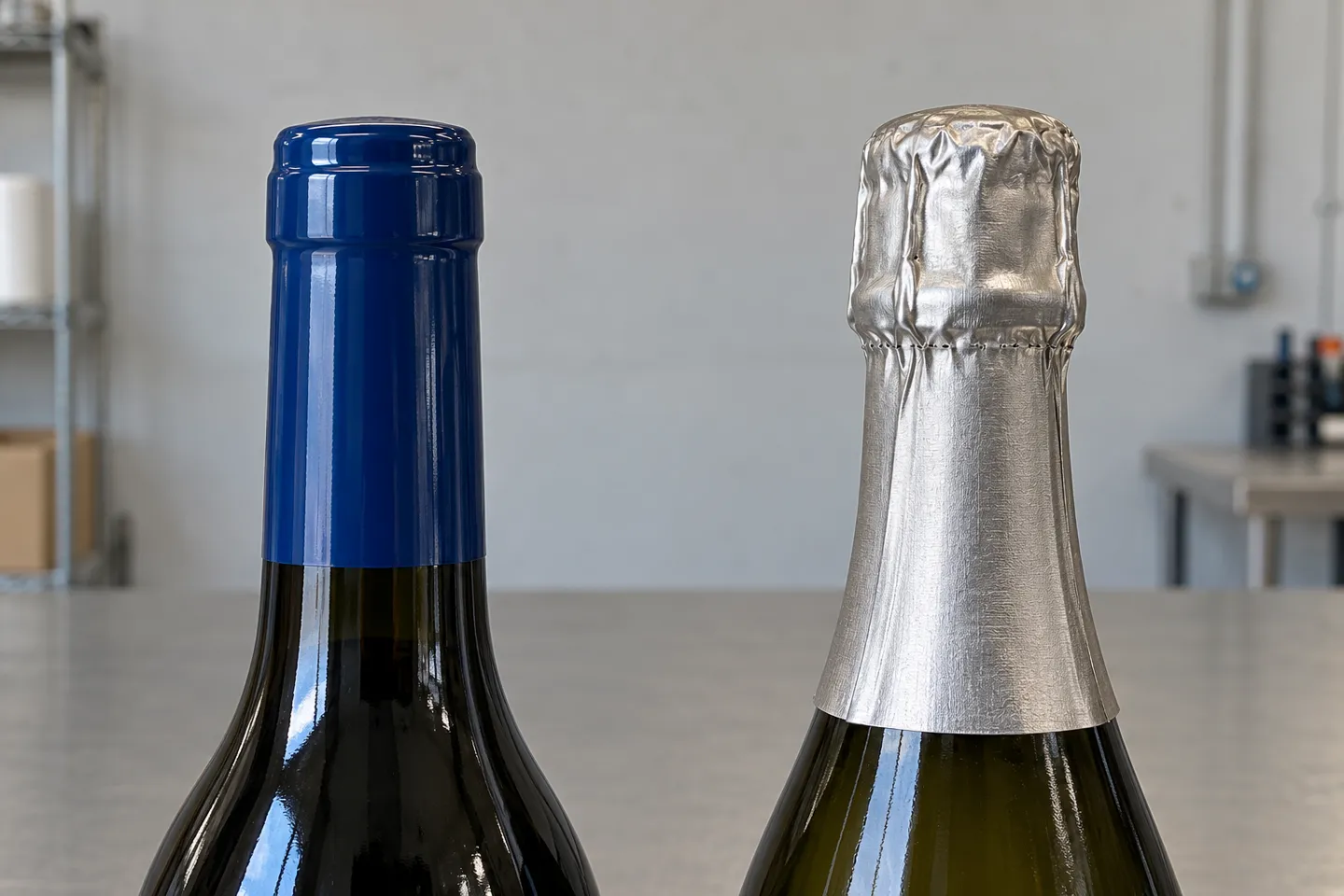
A bottle comes off the filling line with a perfect cork and a bare neck. The heat shrink capsule is the pre-formed hood that finishes the job. Slide it over the neck, apply heat, and it shrinks down to grip the bottle from lip to shoulder. It is a tube of oriented plastic film, usually PVC, made slightly conical so that heat pulls it tight instead of puckering it.
Because the word gets borrowed a lot, two quick disambiguations. A shrink capsule is not shrink packaging, the machines and films that wrap a twelve-pack in plastic and shrink it in a tunnel. That is multipack transport packaging, a different product sold in a different aisle. It is also not a full-body shrink sleeve, the printed film that covers the entire bottle as a label. A capsule covers the neck and the cork top, nothing more.
What it does: gives the bottle a finished look, keeps dust off the cork, and gives the customer a tear tab to open it cleanly. What it does not do: seal the bottle. The closure does the sealing. The capsule sits on top, and its contribution to what happens inside the bottle over years of aging is negligible next to the closure itself. Home-winemaking communities have tested and retested that point in long forum threads.
The buying basics are simple, which is why they are also everywhere. Standard wine capsules run around 30 to 32 mm in diameter and 50 to 60 mm tall in typical supplier listings. You shrink them with a few seconds in boiling water, a steam pass, or a handheld heat gun; commercial lines use a tunnel (Midwest Supplies). Retail packs come in counts of about 100, wholesale supply in case quantities, and custom printing in factory minimums. The rest of this article is about what those basics hide: the material choices, the fit engineering, and the point where a serious producer stops buying caps by the bag.

The Material Map: What Your Capsule Is Made Of
Every property you care about traces back to one decision: what the capsule is made of. Feel, shrink behavior, storage life, and price floor all follow from it. There are six materials in the market. Three matter at volume.
PVC heat shrink film
PVC is the default, and the numbers on it are consistent across supplier and machine data sheets. Flat film stock runs 30 to 75 microns thick for entry-class capsule production, while fully automatic lines work with 60 to 75 micron material. It shrinks fast and low, takes printing well, and costs the least per piece, which is why it covers entry and mid-price wines, specialty oils, and condiments. Its two boundaries: it softens in hot storage, so warehouse climate matters, and because everyone makes it, plain PVC is the most commoditized product in the category. The per-piece price on retail platforms is a race to the bottom, and no buyer thinks a plain black PVC cap is a premium signal.
PET-G: the option almost nobody documents
PET-G shrink film is the quiet middle choice. It is stiffer than PVC in the same gauge, holds its shape better in warm storage, and produces a cleaner, more even shrink with less wrinkling on difficult necks. PET-G gets almost no coverage in buyer-facing content, most guides stop at PVC and polylaminate, so buyers rarely ask for it by name. The trade-off is cost: film stock runs somewhat above PVC. The practical rule: if capsules sit in a hot warehouse or ship through summer temperatures, PET-G is the first upgrade to price out.
Polylaminate and the champagne hood
Polylaminate is a laminated sheet of aluminum and polyethylene layers, around 100 to 120 microns on automatic capsule machine data sheets. It does not work by shrinking. A polylaminate hood is rolled and fitted onto the neck, which is why it feels like rolled tin rather than tight plastic. It resists dents, stores and ships without the heat sensitivity of film, and reads as premium on the shelf. Champagne and sparkling wine hoods are its specialization: skirt gauges of 50 to 70 microns, wrinkle-top or domed-top finishes, and much steeper body tapers. Those tapers run 1:7 to 1:10, against the gentle 1:17 of a shrink capsule. If your wine sells at a price where the cap is part of the promise, this is the material that promise is made of.
Tin, wax, and screw capsules: the short version
Tin capsules have the best hand feel and the worst logistics. They dent in bulk handling, which is why guides warn against bulk packing tin. Wax seals are ceremony, and production reality caps them at small volumes, on the order of under 2,000 bottles a month (an industry capsule production guide). Screw capsules pair with threaded bottle finishes and torque-controlled cappers; there is no shrink step at all. Each holds a niche. None of them scales the way film and laminate do.
Capsule materials at a glance
| Material | Typical gauge | How it fits | Feel | Storage behavior | Best fit | Watch out for |
|---|---|---|---|---|---|---|
| PVC heat shrink | 30-75 µm stock (60-75 µm on automatic lines) | Heat shrinks onto neck | Soft, tight, glossy | Softens in heat | Entry and mid-price wines, oils, condiments | Commodity pricing, heat in storage |
| PET-G | Above PVC, exact spec varies by supplier | Heat shrinks onto neck | Slightly stiffer, cleaner shrink | Best of the films in warm storage | Hot-climate warehousing, difficult necks | Thin public documentation, costs more |
| Polylaminate | 100-120 µm laminate | Rolled and fitted, no shrink | Tin-like, premium | Stable | Premium wines, champagne and sparkling | Higher material cost, needs fitting process |
| Tin | Metal foil | Pre-formed and fitted | Best hand feel | Dents in bulk | Top shelf presentation | Transport damage |
| Wax | Dipped seal | Hand or machine dip | Craft signal | Stable | Ceremony cuvées, tiny volumes | Impractical above small monthly volumes |
| Screw capsule | Aluminum or tin, threaded | Torqued on by capper | Industrial | Stable | Screw-finish bottles | Needs threaded finish and capper control |
The table is the map. The decision it feeds comes next, because material choice is also the point where buying caps and making caps stop being the same question.
Buying Finished Capsules vs Making Your Own
On the buying side, the market is deep and frictionless at the bottom. Retail packs of about 100 capsules are a cart purchase. Bulk bags and wholesale case quantities serve commercial bottlers (Home Brew Ohio). Custom printing goes through packaging factories, with minimum order quantities, proofing rounds, and lead times attached.
On the making side, a capsule production line is a different kind of commitment. Manufacturer data sheets put entry capsule machines near 80 capsules per minute. Mid-range automatic lines typically run 120 to 150 per minute, and high-speed lines run 180 to 220 with 250 as the mechanical ceiling. Output changes with a mandrel and tooling swap, not with a reorder email. Quality control happens online, with defective pieces detected and rejected automatically on mid and high capacity machines.
Buying finished vs producing your own
| Factor | Buying finished | Producing your own |
|---|---|---|
| Cost per piece | Lowest at retail, better at case volume | Falls with run length after the line is paid |
| Customization | Bound by factory MOQs and proofing cycles | Limited by your own tooling and print capacity |
| Lead time control | Supplier’s calendar | Your production calendar |
| Quality control | Supplier’s inspection, checked at receipt | Online inspection and auto-rejection in your plant |
| Scale fit | Small and mid volumes, many SKUs | Steady high volume, few SKUs |
| Skill required | None | Machine operation, tooling changeover, QC |
Three criteria decide the fork. Volume: steady demand measured in hundreds of thousands of caps a year changes the math that case quantities cannot reach. Customization depth: if your capsule needs its own colors, embossing, and exact neck fit, you are already paying custom factory prices per order. Lead-time autonomy: if a delayed capsule shipment can hold your bottling, the line is insurance as much as equipment. The boundary runs the other way too: a producer trialing many SKUs in small batches should keep buying, because changeover and yield costs eat the per-piece saving.
If your numbers land on the making side of that fork, the next conversation is a capsule line sized to your bottle program.
Get a Capsule Line QuoteThe market backdrop makes the decision less about whether capsule demand exists and more about which capsule demand you want. Wine packaging is a growing, steady market, valued at USD 7.34 billion in 2026 and projected to reach USD 9.88 billion by 2033, a 4.34% CAGR (Coherent Market Insights, 2026). Inside that steady total, the value is not spread evenly.
The commodity end
Plain PVC caps, priced per piece on open retail platforms, undifferentiated
The premium end
Polylaminate hoods and champagne capsules, priced on feel and fit, machine-dependent
The specialty end
Large-format and non-wine caps: 5-gallon water bottles, beer kegs, gas cylinder valves, priced on scarcity
The Hinge
Plain PVC competes on price alone. The premium lives in polylaminate, champagne hoods, and specialty sizes.
$7.34B
Wine packaging market, 2026
$9.88B
Projected by 2033
4.34%
CAGR, 2026 to 2033
The rest of this article turns on this split.
Sizing and Specs: Making the Capsule Fit the Bottle
A capsule does not fit a bottle size. It fits a bottle finish, the engineered profile at the top of the neck. Size charts that skip this distinction are where rework starts.
Start from the finish, not the bottle
Every capsule dimension maps to a finish dimension. For standard wine work, manufacturer spec sheets put capsule top diameters at Φ28 to 36 mm and bottom diameters at Φ29 to 37 mm. Heights run 30 to 70 mm. The shrink taper is 1:17. Champagne tooling moves to heights of 70 to 135 mm and tapers of 1:7 to 1:10. The number that generates all of these is the finish drawing: nominal neck diameter, finish height, and taper. Order without it and you are guessing. “It is a 750 ml Bordeaux bottle” is not a spec; two suppliers’ 750 ml Bordeaux finishes can differ enough to turn a tight capsule into a loose one.
Material and gauge by scenario
Reverse-lookup from the scenario beats forward-lookup from the catalog. Hot warehousing or long summer shipping: move from PVC to PET-G, or out of film into polylaminate. Premium tier wine where the cap is part of the promise: polylaminate, and budget for the fitting process rather than a shrink tunnel. High-speed bottling: hold your film supplier to consistent gauge lots, because a line set up for 60 to 75 micron stock runs differently on a thinner reel. Small or narrow necks: standard caps may never shrink fully onto small diameters; confirm complete shrinkage on the actual bottle before ordering in bulk.
Decoration: what to ask for, and what it signals
The decoration ladder runs: plain, flexo or gravure printed, one to three color hot stamping, embossing. Then come the functional details: tear tape with an aluminum tongue for clean opening, breathing holes during shrinking, and a top disc of aluminum foil or no-shrink PVC. One observation matters here. On capsule machine spec sheets, decoration stations and online quality inspection with automatic defective rejection appear on mid and high capacity machines. Entry models leave them off. Capability tracks the equipment. When a capsule supplier quotes you full decoration at commodity prices, the question to ask is which machine ran it, and what its rejection rate was.
The matrix below is the decision tool. Find your bottle type, read across, and check the boundary before you commit to a specification.
Bottle type × capsule spec × failure boundary
| Bottle / use | Capsule spec and material | Failure boundary and check action |
|---|---|---|
| Standard 750 ml cork-finish wine | Top Φ28-36, bottom Φ29-37, height 30-70 mm, taper 1:17, PVC or PET-G | Loose fit if finish data is guessed: get the finish drawing before ordering |
| 375 ml and small bottles | Smaller diameters, same taper logic | Standard caps may not shrink fully on small necks: test full shrinkage on the actual bottle first |
| Champagne and sparkling | Polylaminate hood, skirt 50-70 µm, height 70-135 mm, taper 1:7-1:10, wrinkle or domed top | Taper change needs a full tooling swap: confirm tooling scope, not just machine speed |
| Spirits, short neck | Short heights around 30 mm, PVC/PET-G | Capsule height vs label clearance: check the gap between cap skirt and shoulder label |
| 5-gallon water bottles | Large-format shrink caps, tube film Φ36 mm and up | Oversize reels and mandrels: confirm the line runs your diameter, not just standard caps |
| Beer kegs | Large-format shrink caps, heavier stock | Fit on the keg coupling: check clearance around fittings |
| Gas cylinder valves | Shrink film caps over PP/PE caps | Valve hardware clearance and safety marking rules: confirm with the filler’s compliance owner |
Read each row as a specification with a failure check attached, not as a product picker. The same rows, collapsed into a sequence, become the routine you run before any capsule order.
Before ordering or specifying capsules:
- 1. Bottle finish drawing with nominal diameter, finish height, taper
- 2. Capsule top and bottom diameter against the drawing, not against the bottle name
- 3. Material and gauge, chosen by storage and shipping climate, not by catalog order
- 4. Top disc type: aluminum foil, no-shrink PVC, or open
- 5. Tear tape position and direction
- 6. Shrink or fitting method on your line: dip, steam, heat gun, tunnel, or roll-fit
- 7. Sample run on your own bottles before the bulk order
When Capsules Fail: Wrinkles, Bubbles and Bad Fits
Every capsule failure traces to one of three variables: the film, the heat, or the geometry. Run the diagnosis in that order.
Wrinkles and uneven shrink point to heat handling first. Home and small-batch users document this honestly in winemaking forums: heat guns take practice, and the first few caps are often sacrificed to the learning curve. One winemaker reported a bright red capsule he simply could not shrink evenly, out of a bulk lot of 500. The steadiest method is the least dramatic: a few seconds in boiling water, rotating as it shrinks (Midwest Supplies). A hair dryer is the weakest heat source of the three and produces exactly the mixed results forum users describe.

Bubbles and discoloration mean the film got too hot in one spot. Temperature guidance depends on the heat source class, not on a single number. Supplier guidance for PVC capsules puts handheld devices at 180 to 260 degrees Fahrenheit and steam tunnel machinery at 260 to 280 degrees Fahrenheit (Jelinek Cork Group). Both ranges are correct for their equipment. Problems start when a high setting is held still on one patch of film. Keep the heat moving, and keep the neck dry; residue and moisture cause local barriers that show up as bubbles.
Capsules that never shrink tight are a geometry problem, not a heat problem. If the cap diameter is a step above the neck finish, no amount of heat closes the gap, which is exactly what happens when standard caps go onto small bottles. The fix is upstream of the shrink station: get the finish drawing, match the capsule, and only then tune the process. At production scale, the stakes scale with it. Mid and high capacity capsule lines answer with in-line inspection that detects defective capsules and rejects them automatically. Manual operations compensate with first-article checks and frequent sampling.
The three-overheat signature: bubbles, discoloration, and a burned or weakened patch, all from holding heat still in one spot. If you see all three on one capsule, fix the technique before blaming the film.
The Capsule Business, Reread
Read the previous four sections as a producer instead of a buyer, and three facts line up into one position.
Inventory follows the premium map
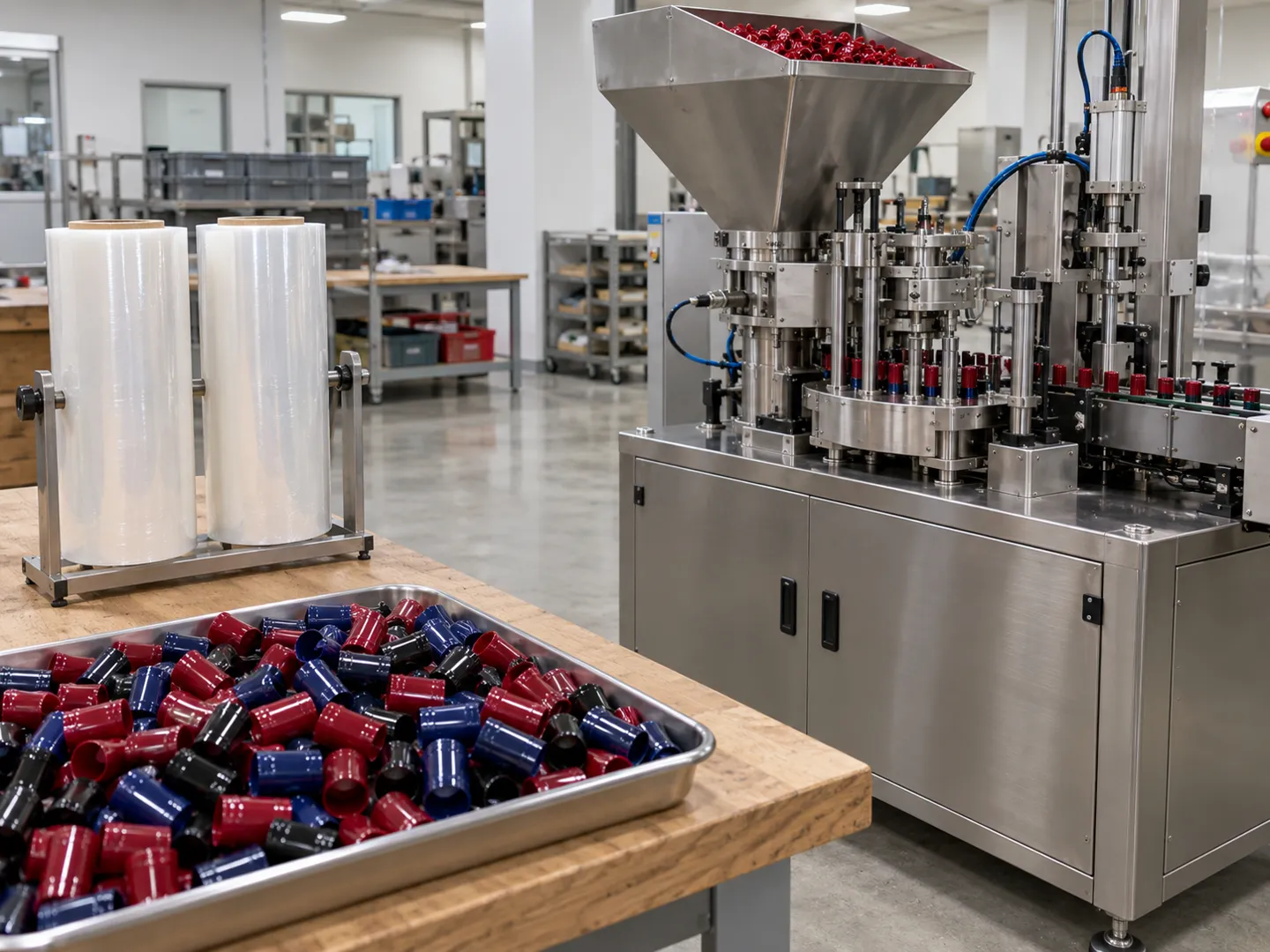
The commodity end is plain PVC: real volume, thin margin, and a price visible to anyone with a browser. The premium end is polylaminate and champagne hoods. Material cost is higher there, but the fitting process, the tooling, and the finish quality are machine capabilities, and a catalog price cannot copy them. The specialty end is large-format and non-wine caps for 5-gallon water bottles, kegs, and gas cylinders. There the competition is thinner and demand steadier, and every order is a specification conversation that starts with a finish drawing. A capsule producer’s stock structure follows the same map. Film rolls in standard gauges feed the volume business. Polylaminate stock and champagne tooling feed the margin business. The customer list splits the same way: volume wineries, boutique estates, and the non-wine accounts most capsule shops never call on.
The equipment checklist is the negotiation
When a capsule line is on the table, the evaluation list is short and unforgiving. Capacity tier against your demand: manufacturer sheets run from about 80 capsules per minute at entry level to 180 to 220 typical on high-speed machines. Mid-range automatics sit at 120 to 150. Material compatibility: some lines take PVC and PET-G film, others also run polylaminate, and champagne work is its own tooling. Decoration stations: hot stamping, embossing, tear tape, breathing holes. Changeover: mandrel counts of 12 or 16 and taper tooling determine what a new bottle program costs you. And acceptance: the machine should be proven on your material before it ships.
The hinge, restated: plain PVC is priced like a commodity because it is one. Polylaminate, champagne hoods, and specialty sizes hold their price because producing them takes tooling, decoration capability, and quality inspection that entry equipment does not have.
That restatement is the whole list of checks in one line. The five checks below are how it turns into a signed order.
Equipment evaluation, five checks before you sign:
- 1. Capacity tier: your real demand against 80 / 120-150 / 180-220 capsules per minute
- 2. Material scope: PVC and PET-G film, polylaminate, champagne hoods
- 3. Decoration stations: hot stamping colors, embossing, tear tape, breathing holes
- 4. Changeover cost: mandrel set, taper tooling, time per SKU
- 5. Acceptance test: full trial run on your own film and bottles before shipment
On that last check, this is where we would point you at concrete specifications rather than adjectives. KETE’s capsule range spans the three capacity tiers. The automatic models run online capsule quality inspection with automatic rejection of defective pieces. Every machine is test-run on the customer’s own material before shipment. Compare the wine capsule machine range against your bottle program and your own five-check list, and let the specification sheet argue for itself.
Next Step
Ready to Produce Your Own Capsules?
KETE capsule lines span the three capacity tiers, from about 80 to 220 capsules per minute, with online quality inspection and a test run on your own material before shipment.
Start the Five-Check EvaluationReferences
- Coherent Market Insights. “Wine Packaging Market Size, Trends & Forecast, 2026–2033.” 2026. coherentmarketinsights.com
- Jelinek Cork Group. “Shrink Caps.” jelinek.com
- Midwest Supplies. “How to Use Shrink Caps on Wine and Beer Bottles.” midwestsupplies.com
- Home Brew Ohio. “PVC Heat Shrink Capsules for Wine Bottles.” homebrewohio.com