 EN
 RU
 ES
 FR
 AR
 PT
 IT
 ID
 KO
 TR
 DE
 VN
 TH
 IN
 JA
 ZH
 MS

What a Champagne Capsule Is (and What It Is Not)
Above the cork of every champagne and sparkling wine bottle sit two layers: a wire cage, and a metal hood that covers the cage and the top of the neck. The hood is the capsule. It slides over the cork and cage in one piece, with two parts: a skirt that runs down the neck, and a top disc that caps the whole assembly. The capsule keeps dust and moisture off the cork, stops the sharp ends of the cage wires from catching on shelves and sleeves, and carries most of what you see of the brand on a crowded shelf.

When the bottle is opened, the capsule is peeled or cut away first. Sommeliers and retailers give one piece of advice about where to cut: below the second lip of the foil, low on the neck. Wine can pool inside a capsule during storage and transport, and a cut made high leaves that pooled wine running over the pour. It is a small detail, but it explains why the capsule is treated as part of the pour, not just part of the package.
One naming problem needs clearing before anything else. In collecting circles, “capsule” means something different: the small metal disc seated on the very top of the cage, above the capsule proper. Collectors trade these discs on dedicated platforms, and the hobby has a name of its own. This article uses capsule to mean the foil hood over cork and cage, from here to the end. The equipment world has a similar split: machines that make capsules from rolls of material, and machines that apply a finished capsule onto the bottle at a bottling line. They are different purchases for different businesses.
Two checks before you read on
- If the object you have in mind is a small round metal disc traded by collectors, that is the cage plaque, not the capsule covered here.
- If you are looking for equipment, decide first whether you want to MAKE capsules from roll material or APPLY finished capsules at a bottling line; the rest of this article is about making them.
Collecting is a real market and it feeds capsule design, since collectors prize exactly the decorated tops that brands use for identity. But the money question for most readers sits further down the chain: what a capsule is made of, what it costs, and whether producing them beats buying them. That is where the rest of this article goes.
How a Champagne Capsule Differs from a Wine Capsule
A champagne capsule looks like a taller wine capsule, and “taller” is where most people stop. The differences that matter sit in four specifications, and each one exists for a physical reason.

Skirt Length: 70 to 135 Millimeters
Champagne and sparkling wine capsules run from 70 to 135 mm in height, against 30 to 70 mm for still wine capsules, per manufacturer specification ranges (manufacturer published specifications, 2026). The extra length is not decoration. The skirt has to cover the cage and the cork top in one continuous surface, which still wine capsules never need to do. Retail foils for home winemakers, sold at about 4.5 inches and crimped by hand, sit inside the same window (PI Wine, n.d.).
Taper: Three Ratios Instead of One
A capsule is a cone, and the cone has to agree with the bottle. Champagne capsule tooling comes in 1:7, 1:8 and 1:10 taper ratios; still wine capsule tooling commonly runs 1:17 (manufacturer published specifications, 2026). The ratio is a property of the tooling, not a setting you adjust at the machine. A producer who changes bottle format is, in practice, changing mandrels, cutting knives and punching tools with it.
Tops: Wrinkle and Domed
Sparkling wine capsules form in two top styles: the classic gathered wrinkle top, and the smooth domed top. Both are formed in production, on the same class of machine, and the top disc accepts its own decoration, usually one or two colors of hot stamp. The top is where the brand lives, which is why collectors prize it and why producers protect it.
Material and Thickness Windows
The premium champagne capsule is made from polylaminate, a layered composite of aluminum and polyethylene that balances print quality, stiffness and cost (Wine Business Monthly, 2019). The thickness windows differ by capsule class. Polylaminate skirt material for champagne capsules runs 50 to 70 microns. Still wine polylaminate capsules run 100 to 120 microns, and heat-shrink PVC or PET-G capsules for wine and spirits run 60 to 75 microns (manufacturer published specifications, 2026). Top diameters span roughly 28 to 44 mm across still wine machine families, with champagne-class tooling centered near 30 to 34 mm.
The table below puts the whole family in one frame. Read the boundary column before quoting any number from it.
Capsule family: construction, use and failure boundaries
| Capsule type | Construction specs | Where it is used | Failure boundary |
|---|---|---|---|
| Champagne long-skirt capsule | Skirt 70-135 mm, taper 1:7 / 1:8 / 1:10, polylaminate skirt 50-70 mic, wrinkle or domed top, top dia approx. 30-34 mm | Champagne and sparkling wine, over cork and cage | Changing bottle format requires matching tooling; 1:7 tooling will not seat on a 1:17 neck profile, so confirm taper and mandrel set before any format change |
| Still-wine short capsule | Skirt 30-70 mm, taper 1:17, polylaminate 100-120 mic or PVC/PET-G 60-75 mic, top dia 28-44 mm by model | Still wine, spirits, beer, olive oil and condiment bottles | A shorter skirt never covers a cage; do not substitute a wine capsule on a sparkling finish, and confirm cork finish diameter before ordering |
| Spirits capsule | Decorated shrink PVC or polylam, sized to the bottle’s shoulder and neck | Liquor bottles where shelf identity carries the sale | High shoulder profiles need their own tooling; artwork on shrink film must be approved against the actual bottle, not a drawing alone |
Spirits capsules belong to the same family and share the same machines, which is why capsule producers treat wine, champagne and spirits as one production domain with different tooling sets, not three businesses.
Buying Champagne Capsules: Three Supply Paths and One New Rule
How you buy capsules depends almost entirely on volume, and the three paths below assume nothing beyond that.
The first path is retail supply. Home winemakers and small trial batches buy finished foils by the box: hand-crimpable 4.5 inch champagne foils start around US$29.99 per box from winemaking suppliers (PI Wine, n.d.). You slip the foil over the cage and crimp it by hand, no heat, no machine. The specification is fixed by the supplier, so this path ends the moment you need your own artwork or a non-standard bottle.
The second path is custom supply from a capsule converter. This is where wineries and brands go for identity capsules. The inquiry needs a specific list to get a quote at all: top diameter, capsule height, taper ratio, top style, opening method, decoration set, material and quantity. Price follows decoration complexity, because every decorative effect is a station on the converter’s line, which the next section shows in detail.
The third path is making capsules in-house. It exists, it is real, and it only clears its threshold at serious volume, because it means running a production line, which the next section also covers. Treat it in this section as one branch of the map, not a recommendation.
Retail box
Hand-crimp foils, about US$29.99 per box, fixed specs, no artwork, for home and trial scale.
Custom converter
Your specs and artwork, price scales with decoration, MOQ and tooling quoted per project.
In-house line
Roll material to finished capsule under your roof, cleared only at volumes that keep a line busy.
One rule changed the ground all three paths stand on. Since 2023, a European regulation has made the foil capsule optional on sparkling wine bottles across the EU. Each protected designation of origin can still require it in its own rules. Champagne’s own committee ran a consumer study, concluded that removing the capsule posed no significant risk to the appellation’s image or sales, and ended its request to keep it mandatory (Vinetur, 2025). Most houses still capsule their bottles, because the capsule now does a brand job rather than a compliance job.
The EU change is a market fact, not a trend prediction: since 2023 the capsule on sparkling wine is optional unless an appellation requires it.
If you budget capsules as a compliance line, re-read that budget as a brand line. Outside the EU, check local rules before assuming the same freedom applies.
If the in-house path is on your map from the three above, the quote that matters is built from real inputs: bottle formats, taper ratios, decoration set and target output.
Request a Capsule Line QuoteHow Champagne Capsules Are Manufactured
Every path above ends at the same place: a production line that turns printed or plain rolls into finished capsules. Champagne capsules follow the same chain as still wine capsules, with tighter tolerances and more decoration stations.
Forming: Mandrels, Not Settings
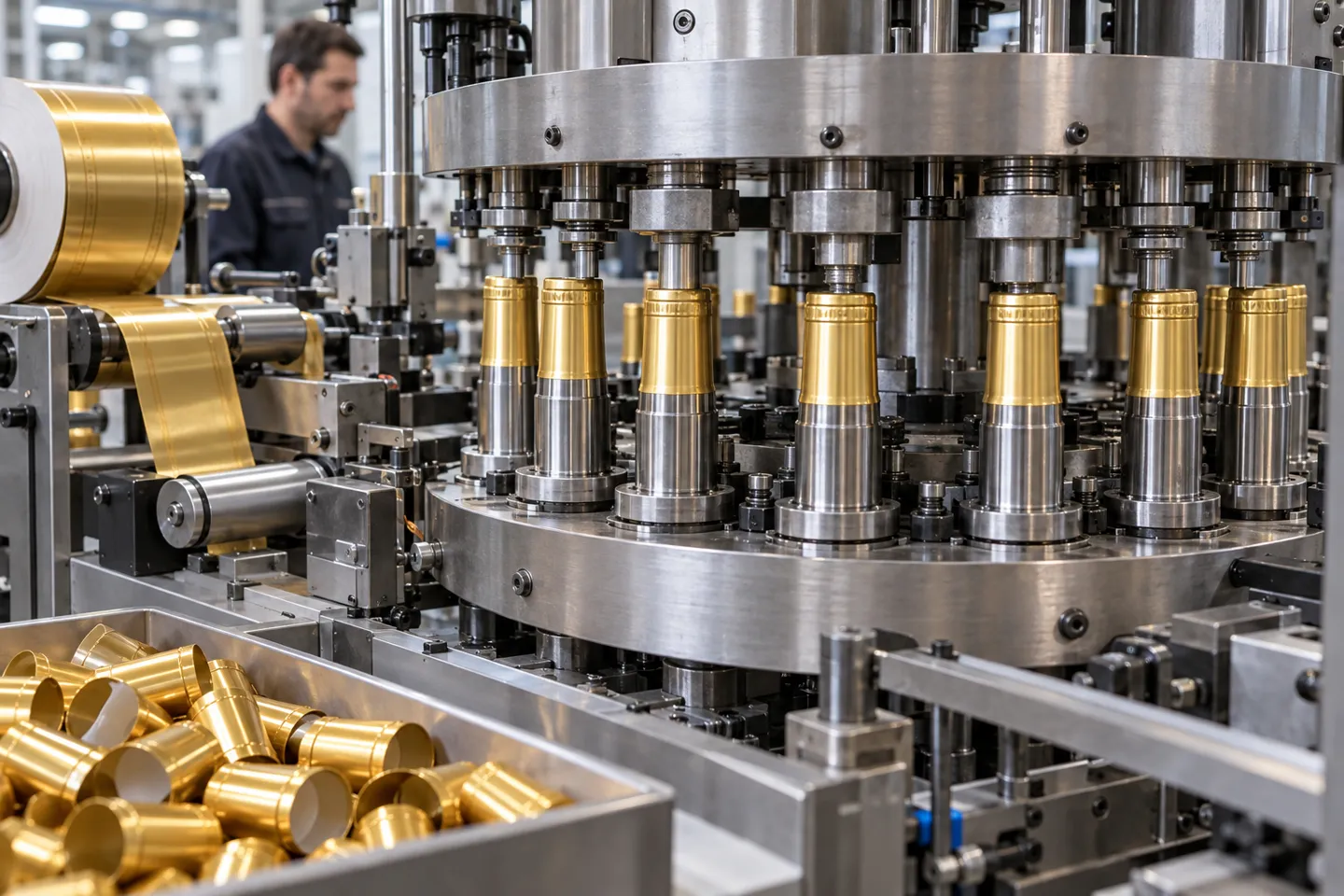
The heart of the line is a rotary head carrying twelve mandrels. Each mandrel is one capsule diameter; the capsule is formed around it, skirt and top together. Champagne-class machines form both wrinkle tops and domed tops from polylaminate skirt material, and add a separation ring and vertical grooves that help the finished capsule grip the bottle (manufacturer published specifications, 2026). Changing capsule size means changing mandrels, the skirt cutting knife and the top disc punching tool; a standard kit ships with thirteen mandrels, twelve in the turret and one spare (manufacturer published specifications, 2026).
Roll to capsule
Unwind printed or plain polylaminate or shrink film, edge-guided
Form the skirt around mandrels on a 12-station turret
Punch and form the top disc, wrinkle or domed
Emboss, roller for full-surface pattern and platen for high-pressure marks
Hot stamp the skirt in up to 3 colors and the top disc in 1 to 2
Apply solvent-based or hot-melt glue
Punch horizontal perforations and fit the tear-off tape with aluminum tongue
Register print marks by sensor
Inspect online and reject defective capsules automatically
Count and offload
Decoration and Opening: Where the Capsule Earns Its Price
Decoration is not printing on a flat sheet. It is a sequence of stations, each with its own tooling: continuous full-surface roller embossing, high-pressure platen embossing, one to three colors of skirt hot stamping, and top disc stamping and embossing. The opening features are stations too: horizontal perforation, hole punching, and a tear-off tape backed with an aluminum tongue, so the capsule opens cleanly instead of shredding into sharp foil. Material arrives pre-printed or plain. Converters feed the line with gravure-printed stock at 150 to 180 m/min and slit it upstream at 400 to 600 m/min. The print-mark sensor station keeps artwork aligned to the cut (manufacturer published specifications, 2026).
Inspection, and What Speed Really Means
Every machine in this class quotes two speeds, and the gap between them is the real number. The champagne-class line runs 130 capsules per minute mechanical and 100 to 120 in production. Standard still-wine lines run 160 mechanical against 120 to 150 effective, and high-speed lines 250 mechanical against 180 to 220 (manufacturer published specifications, 2026). The gap is the decoration load: every embossing, stamping and punching station costs cycle time, which is why the most decorated capsule is also the slowest to make. Online inspection with automatic rejection of defective capsules runs across this output, replacing manual re-checking. For floor planning, a champagne-class line occupies roughly 8.5 by 3.4 meters, weighs about 5.5 tonnes and draws 25 kW (manufacturer published specifications, 2026).
Machine class vs speed reality
| Machine class | Mechanical speed | Production speed | Built for |
|---|---|---|---|
| Champagne class (polylam, 70-135 mm skirts) | 130 capsules/min | 100-120 capsules/min | Champagne and sparkling capsules with heavy decoration |
| Standard wine class | 160 capsules/min | 120-150 capsules/min | Still wine and spirits capsules, PVC or polylam |
| High-speed wine class | 250 capsules/min | 180-220 capsules/min | High-volume still wine lines, servo-driven |
Where Capsule Production Goes Wrong
Failures in capsule production cluster in four places, and each has a control that actually works.
The first place is incoming material. Print defects on pre-printed stock, or material thickness outside its window, cannot be repaired anywhere downstream; the capsule is formed from exactly what the roll carries. Incoming inspection is the only gate that works, which is why converters pin thickness windows (50 to 70 microns for champagne skirt material, for example) at goods-in rather than at the machine.
The second place is the process itself. Print-mark drift shows up as artwork that does not meet the cut line; the sensor station exists to catch it, but it works only if the incoming print is consistent. Double capsules, where two foils leave the line stuck together, originate in winding and handling and surface at the bottling hall as a line stop. And offcut waste is a permanent cost line: punching capsules out of web leaves polylaminate scraps, enough that a 2025 preprint is devoted to repurposing them (Tsutskiridze, Research Square, 2025).
The third place is design. Tear-off geometry decides whether the capsule opens cleanly or shreds; the aluminum tongue exists to give the tear a start and a finish. Perforation patterns, continuous or interrupted, change both the opening feel and the tooling cost, so they belong in the design review, not in a service call.
The fourth place is the consumer’s hand. The instruction to cut below the second lip exists because wine pools inside capsules; a capsule that traps liquid at the cut line turns a storage detail into a service complaint. Design, bottling practice and bar staff training form one system, and a failure in any of the three lands on the capsule.
Four failure gates and the control for each
- Incoming material defects: gate at goods-in with thickness windows
- Print-mark drift: keep incoming print consistent and trust the registration sensor only for process drift
- Winding and offcut waste: schedule handling and scrap repurposing as production tasks, not afterthoughts
- Opening geometry: fix tear-off and perforation design at the tooling stage, before the first production run
What This Means for Capsule Producers
The EU rule and the production economics point in the same direction, and the comparison below is the whole argument.
The basic capsule band, mostly still wine, undecorated shrink or plain polylam, competes on price and lead time. It now competes against no capsule at all for part of its former volume. When a regulation makes the capsule optional and a committee-level consumer study finds no image risk, the undifferentiated end of the market loses its floor (Vinetur, 2025).

The decorated sparkling band sits on the other side of the split. A champagne capsule with wrinkle or domed top, roller and platen embossing, multi-color hot stamping and a clean aluminum-tongue tear is brand identity in physical form. Removing it costs the house a visible cue that no compliance argument replaces. The same decoration load makes it slow to produce: 100 to 120 capsules per minute against 180 to 220 for high-speed still-wine work. That load is what makes it hard to commoditize. The tooling for tapers, tops, perforations and tongues is a threshold a competitor has to buy before quoting against you.
Two demand bands after the EU change
| Dimension | Basic still-wine band | Decorated sparkling band |
|---|---|---|
| Demand direction | Part of former volume can go uncapsulated, floor dropping | Carries brand identity, no substitute by rule change |
| Competition basis | Price and lead time | Tooling depth: tapers, tops, tear-off, inspection |
| Margin logic | Compressed toward cost | Decorated complexity prices as value, not cost |
| Capacity risk | Needs volume to stay busy | Needs decoration stations and changeover discipline |
For a capsule producer reading this as a configuration decision, the direction is the table’s right-hand column: weight capacity and tooling toward long-skirt decorated sparkling capsules. Treat tear-off with aluminum tongue, one-to-three-color skirt hot stamping, dual embossing and online inspection as the quote’s floor, not its ceiling.
This is the chain we build machines around at KETE. Our champagne capsule line forms wrinkle and domed tops from 50 to 70 micron polylaminate skirt material, at 100 to 120 capsules per minute. It carries roller and platen embossing, one-to-three-color skirt hot stamping, an aluminum-tongue tear-off, and online inspection that rejects defective capsules automatically. The full champagne capsule machine specifications are published. For still-wine and spirits volumes, the same logic runs faster on the C and D series. If your volume sits between buying capsules and running a line, that is exactly the conversation worth having with real numbers.
Build Your Capsule Line on Real Numbers
KETE champagne capsule machines take polylaminate roll to inspected capsule with wrinkle or domed tops, 1 to 3 color hot stamping, an aluminum-tongue tear-off and online rejection, at 100 to 120 capsules per minute.
Get a Champagne Capsule Machine QuoteReferences
- Vinetur. “Champagne Producers No Longer Required to Use Foil Capsule on Bottles under New European Regulation.” 2025. vinetur.com
- Wine Business Monthly. “The Art and Science of Capsules: From Design to Bottling.” 2019. winebusiness.com
- Tsutskiridze, M. “Reduction of Material Waste in Production of Sparkling Wine Bottle Capsules.” Research Square preprint, 2025. researchgate.net
- PI Wine. “Capsules and Capsuling Equipment.” piwine.com