 EN
 RU
 ES
 FR
 AR
 PT
 IT
 ID
 KO
 TR
 DE
 VN
 TH
 IN
 JA
 ZH
 MS

A corked bottle of gin comes off the filler with a rough paper top and a bare plastic shrink band that never quite sat flat. Six weeks later the tamper tape has lifted at one edge, the bar top wobbles when the shelf temperature swings, and somebody in the tasting room is peeling the whole thing off with a thumbnail. The capsule on a liquor bottle does three jobs: decoration, tamper evidence, and dust protection. It fails all three for reasons that have almost nothing to do with the material it is made from.
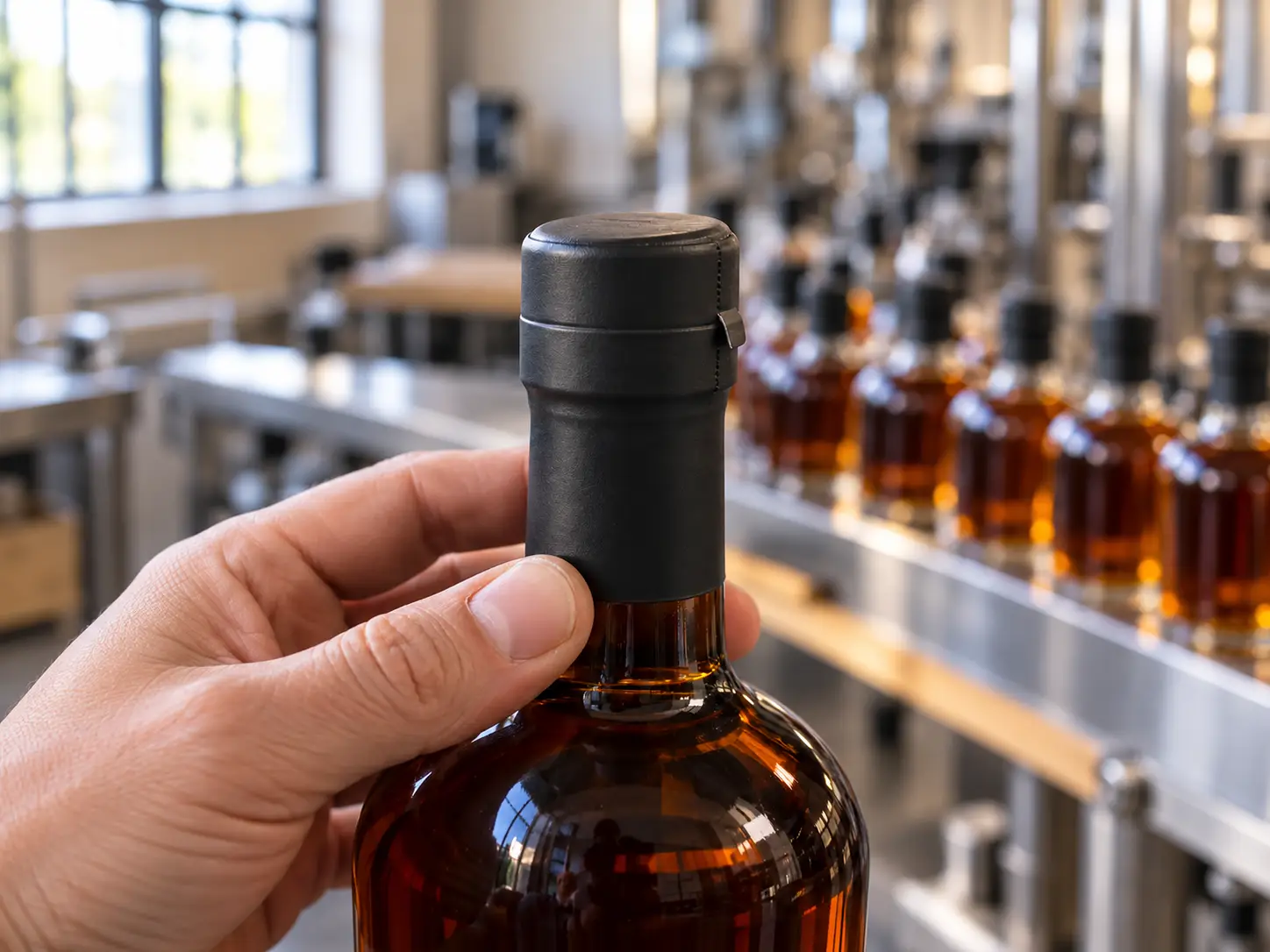
Start With the Fit: What a Liquor Bottle Capsule Has to Do
The capsule, sometimes called a neck foil, is the sleeve that covers the closure and the upper neck of a wine or spirits bottle. It makes the bottle look finished, and it tells a customer at a glance whether the bottle has been opened. It also keeps dust out of the closure area. In this article, capsule always means this neck foil, not the supplement kind.
One misconception is worth clearing up immediately: a capsule is not the seal. The cork, the screw cap, or the bar top stopper does the sealing. If your actual problem is a bottle losing pressure or leaking, a different capsule will not fix it, and no amount of shrink tension will save a bad closure fit.
What a capsule does depend on, more than anything else, is size. Capsules are ordered by the outer diameter of the bottle neck finish and the length of the capsule itself. Retail listings for PVC shrink capsules cluster around 30, 30.5, and 32 mm diameters with a 60 mm length (Amazon product listing). On screw-finish bottles the industry code for the matching neck is BVS 30H60, a standardized 30 mm by 60 mm profile maintained by CETIE (CETIE finish data sheet GME 30H60). Bottles closed with a bar top stopper need one more number confirmed before anything is ordered: the diameter of the top hat the capsule has to cover.
Get that one measurement wrong and nothing else in this article matters. The capsule either will not go on, or it goes on loose, and loose is where every failure story starts.
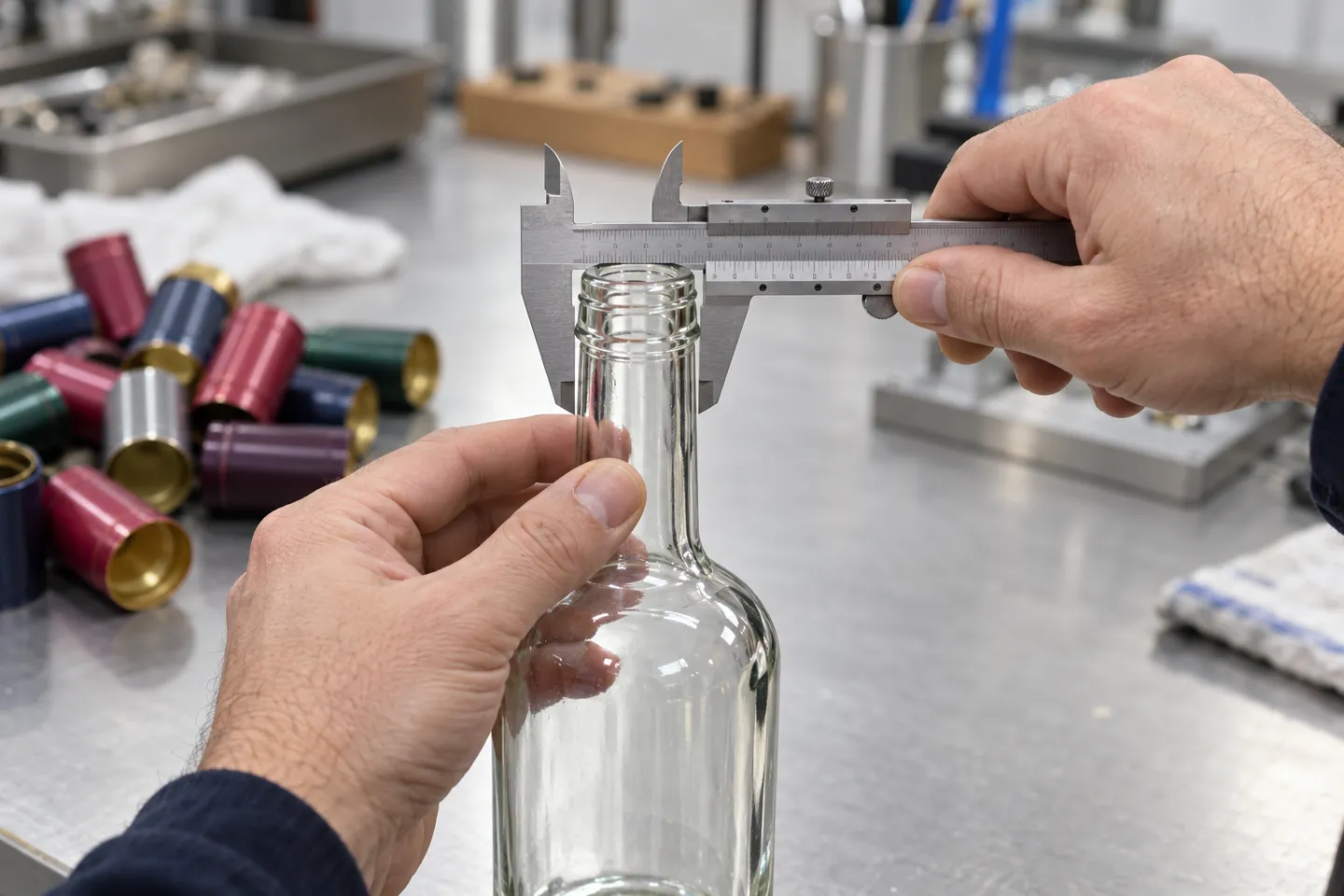
Getting Capsules Onto the Bottle: Methods and What Goes Wrong
There are three ways to shrink a capsule onto a bottle at small batch scale, and each one has a single judgment call that decides whether it works.
Three ways to shrink, one judgment call each
Boiling water dip
Tongs, one to two seconds, dry neck.
Heat gun on low
Low heat, always moving, label stays safe.
Steam
Slowest, safest choice for printed labels.
The first is the boiling water dip. You hold the capsule on the neck with tongs and dip it for a second or two. The judgment call is timing: home winemakers report that caps applied this way shrink unevenly when the timing or the bottle temperature is wrong, ending up wrinkled rather than tight (WineMakingTalk).
The second is a heat gun on low, rotating the bottle so the capsule shrinks evenly instead of scorching on one side. The judgment call is distance. Too close will burn through PVC and scorch the label underneath, which turns a finishing touch into a returns problem.
The third is steam, gentler than both, slower, and the usual recommendation for anyone nervous about labels.

Whatever the method, one rule comes before all three: let the bottle reach a stable temperature first. A bottle fresh off a warm filling run is still exchanging heat with the room. As the headspace air warms and expands, it pushes against the closure, and on short-necked bottles that push is enough to slide the whole capsule upward.
Shrink checklist
- Bottle at room temperature, filling run finished at least hours ago.
- Method chosen: water dip 1-2 seconds, heat gun low and rotating, or steam.
- Neck wiped dry before the capsule goes on.
- After shrinking, twist test: the capsule should not rotate on the neck.
- If it is loose: re-shrink once, then drop one diameter size.
- If it rides up or the tamper tape pops: check bottle temperature first, then neck height against the capsule length.
That last line in the checklist is the one worth rereading. When capsules ride up or tamper tape pops off, the instinct is to blame the application technique. Often the technique is fine and the bottle is the variable.
The Material Axis: Heat-Shrink, Roll-On, and Why Failures Follow the Process
Capsules divide into two families by how they get onto the bottle, and that division explains nearly every failure you will read about in this article. Heat-shrink capsules, made from PVC or PET-G film, grip the bottle by shrinking under heat. Roll-on capsules, made from aluminum foil or a polylaminate, are pressed into shape mechanically and never see heat at all.
| Material | How it goes on | Cost and look | Typical use | Where it fails |
|---|---|---|---|---|
| PVC heat-shrink | Boiling water, heat gun, or steam | Lowest cost, wide color range | Still wine, spirits, hobby bottling | Uneven shrink, loose fit, heat damage to labels |
| PET-G heat-shrink | Same methods as PVC | Similar cost, better clarity | Clear or printed shrink capsules | Same as PVC |
| Aluminum foil (lead-free) | Mechanical roll-on | Mid to premium | Commercial still wine | Poor rolling pressure, scratches |
| Polylaminate (aluminum with polyester or polyethylene layers) | Mechanical roll-on, no heat | Premium finish | Commercial wineries, sparkling wine | Fit and rolling pressure, never heat |
Heat-shrink capsules: PVC and PET-G
This is the family most people picture, and for good reason: it is the cheapest way to finish a bottle and the easiest to find in small quantities. PVC shrinks sharply and evenly when it is heated, takes printing and color well, and is the standard capsule on bar top spirits bottles. PET-G behaves the same way with better clarity, which matters for transparent or windowed designs.
The important thing to understand is that heat-shrink capsules fail because of heat and fit, not because of the film. A cheap PVC capsule applied to a bottle at stable temperature, in the right diameter, stays put for years. The same capsule rushed onto a warm bottle or ordered one size up from the neck does not. When you read complaints about shrink capsules, almost every one traces back to one of those two causes rather than to the material itself.
Roll-on capsules: aluminum foil and polylaminate
The premium family works without any heat at all. A polylaminate capsule is a laminate of aluminum with polyester or polyethylene layers, and it is rolled and spun into place under mechanical pressure, which is why it carries the crisp look commercial wineries use for tamper evidence and brand presentation (Freshmoon Packaging, 2016). On sparkling wine and champagne bottles the capsule sits over the cage and crowncork, and the top is formed around them.
Because there is no shrinking, there is no shrink failure. What replaces it is a mechanical one: if the rolling pressure or the capsule size is off, the capsule sits loose on the neck or scratches as it is formed. The failure moved from the heat source to the tooling, and that distinction matters when you are diagnosing a batch.
Sizing: the number that decides everything
Across both families, the first confirmation is the same: neck outer diameter and capsule length, typically somewhere in the 28 to 32 mm by 45 to 60 mm band, with bar top bottles needing the top hat diameter confirmed as well. The famous short-neck failures you will meet in the next section are sizing problems at their core. Diameter is the number everyone checks; height is the one that gets skipped, and it is the one that decides whether a temperature swing can lift the capsule off the shoulder.
Sizing quick reference
28-32 mm
neck outer diameter
45-60 mm
capsule length
+ 1
extra check: top hat diameter on bar top bottles
Screw-finish shorthand: BVS 30H60 is a standardized 30 mm by 60 mm neck profile, maintained by CETIE.
One adjacent option for completeness: wax seals. They substitute for a capsule entirely, suit a handmade positioning, and cannot be run on a shrinking line, so they are a brand decision rather than an equipment upgrade.
Where Capsules Don’t Work: Boundaries and Failure Cases
Everything above describes capsules behaving well. This section is about the other case, and it draws on distillery and home-bottling threads rather than on product pages, because failures are documented by the people who mopped them up, not by the people who sold the capsules.
Documented case
On short-necked bottles, a rise in temperature pushed the bar tops out and popped the tamper tape off the shrink capsules. The distillery switched to clear shrink bands and changed how it handled the bottles.
Source: ADI Forums, Packaging section, 2015
Three failures worth copying before they happen
The first failure is the ADI Forums case above. Distillery staff found that on their shorter-necked bottles, warmth was enough to push the bar top outward, and the capsule, anchored to a neck that no longer matched, lifted and broke its tamper seal (ADI Forums, 2015). The failure point is the combination of neck height and thermal expansion. The checkable action: before ordering, measure total neck height on your actual bottle, not the catalog photo, and ask what happens to it across your storage temperature range.
The second is the screw-cap dispute. On a home-brewing forum, members debating shrink wraps over screw caps concluded that a wine bottle neck may not be strong enough for the process and recommended staying with plain screw caps (The Homebrew Forum). Retail products, meanwhile, are marketed as screw-cap compatible. Both can be right, because the variable is the specific bottle. The checkable action: treat screw-cap-plus-capsule as a per-bottle confirmation, testing on your own bottles before committing a batch, rather than a yes-or-no rule.
The third is the timing failure: shrink caps applied while the bottle was still warm shrunk loose, and the fix was simply waiting for a stable bottle before capping (WineMakingTalk). The checkable action: make bottle temperature a gate in the capping procedure, not a judgment call at the bench.
The boundary matrix by bottle type
| Bottle scenario | Capsule that fits | Where it fails | What to check first |
|---|---|---|---|
| Standard still wine, cork | PVC or PET-G heat-shrink, 30-32 mm | Loose shrink on warm bottles | Bottle temperature before capping |
| Sparkling and champagne | Polylam roll-on over the cage | Top forming around the cage, rolling pressure | Cage height and top diameter |
| Spirits with bar top stopper | Heat-shrink with top hat, or roll-on bar top capsule | Top hat diameter mismatch, thermal lift on short necks | Top hat diameter and total neck height |
| Screw cap bottle | Shrink band if the bottle tolerates it | Neck strength varies by bottle | Test on your own bottles first |
| Short-necked bottles | Clear shrink band worked where capsules did not | Temperature swing lifts capsule and tamper tape | Neck height across storage temperatures |
| Barrel water and gas cylinders | Large-format heat-shrink sleeves | Same material logic at a bigger size | Sleeve size against container neck |
Read the matrix row by row against your own bottle, and note that not one of the failure cells says “buy a better capsule.” Every one of them says “check a dimension or a condition first.”
Matching the Capsule to the Bottle and the Wine
By this point the choice is mostly narrowed already. Four questions finish the job.
First, the wine or spirit. Still wines and spirits take heat-shrink capsules in most cases. Sparkling wines want a roll-on polylaminate capsule formed over the cage, which is why champagne bottles look different at the neck. Second, the bottle: neck outer diameter, total neck height, and, for bar tops, the top hat diameter. Third, the retail context: if tamper evidence is doing selling work on the shelf, a tear tab and a printed body are worth specifying up front. Fourth, the volume: at a hundred bottles, applying capsules by hand is a reasonable afternoon. At ten thousand, application quality becomes a production question, and capsule supply becomes a sourcing decision with tolerances attached.
Capsule selection in four questions
- Wine type: still or spirits = heat-shrink; sparkling = polylam over the cage.
- Bottle: neck OD, total height, bar top diameter confirmed on the actual bottle.
- Shelf job: tear tab, printed body, tamper band specified or not.
- Volume: hand application batch vs purchased capsules by spec vs producing capsules in-house.
The last branch of that fourth question deserves its own paragraph. From a few thousand bottles onward, some wineries and distilleries stop being capsule customers and start wondering whether they should be capsule producers. That is a different conversation, and it runs on different numbers.
From Buying Capsules to Making Them
Seen from the production side, a capsule is a converted product: printed film becomes tube, tube becomes cut capsules, decoration and inspection happen on the way through, and the whole chain exists to deliver one thing, capsules that fit the bottle consistently. The failure list in the matrix reads differently from this side of it. Every cell that said “check a dimension or a condition” is a quality capability a producer either has or does not: neck-height tolerances honored in the film and cutting stages, and inspection that catches a bad capsule before it ships rather than after it lifts on a shelf.
The production line follows the same material axis as the capsules themselves. A heat-shrink capsule line runs PVC or PET-G film. It serves the still wine, spirits, and craft market, where volume per SKU is lower and decoration changes often. A polylaminate line serves the sparkling and premium end, where the value sits in top forming and embossing rather than raw speed. Choosing between them is less a machinery decision than a decision about which customers you intend to hold. Capacity claims deserve one caution in either direction: published machine speeds are a range, not a promise. Across publicly listed capsule machine models, production speeds run from around 80 up to 220 pieces per minute depending on the version, and the highest mechanical figure in a brochure is not the number a bottling schedule should be built on.
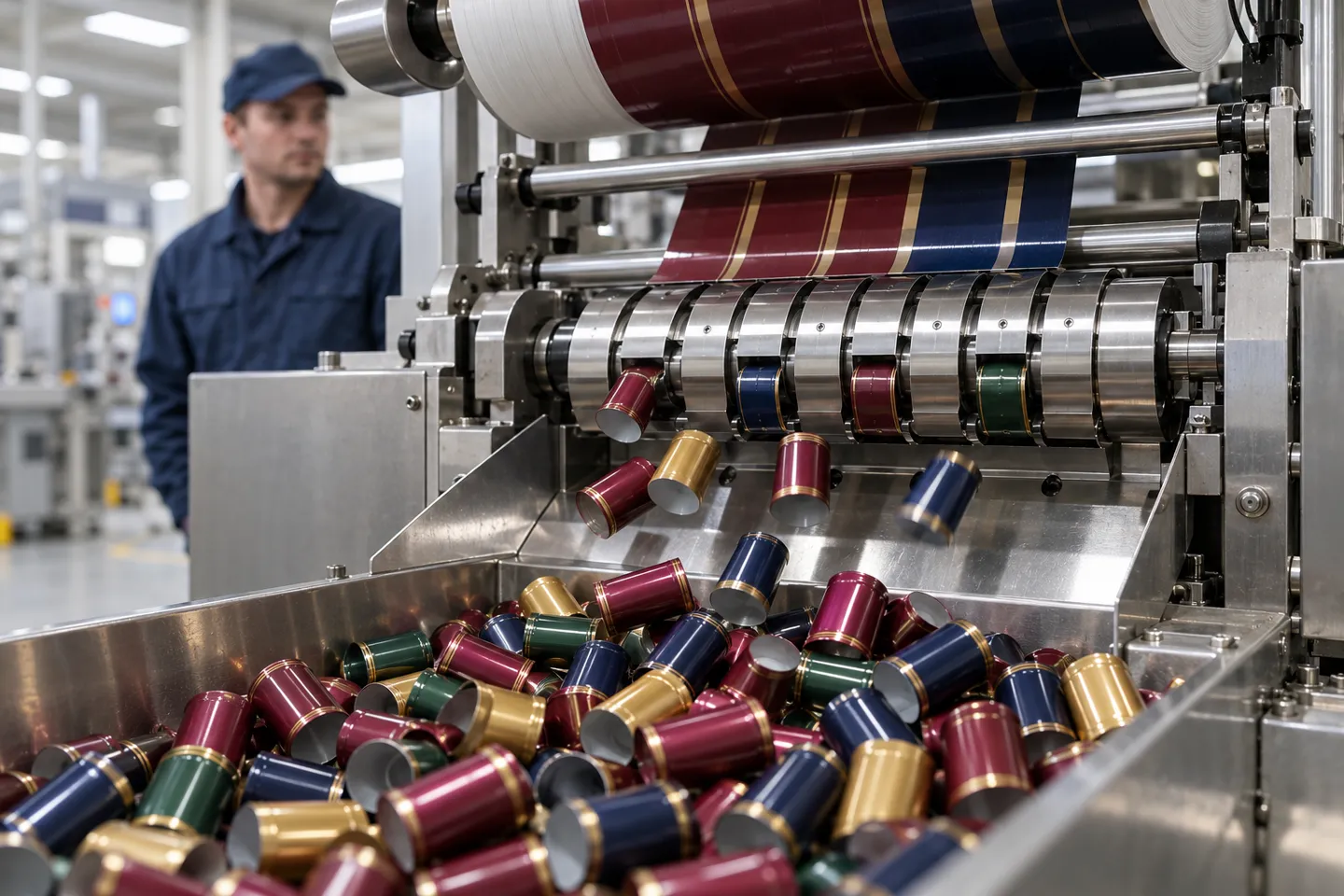
KETE builds both sides of that split: our heat-shrink lines run PVC and PET-G capsules in three tiers from 80 to 150 pieces per minute, our high-speed version adds online inspection with automatic rejection of defective capsules at 180 to 220 pieces per minute, and our polylam line forms champagne and sparkling capsules with embossed tops. If you are weighing a wine capsule production line, we will match the configuration to the wine styles you actually bottle.
Whether you buy capsules by the box or make them by the hundred thousand, the discipline is identical. Fit is a measurement taken on your own bottle, heat is a condition you control, and the capsule that survives a temperature swing on a warehouse shelf is the one that was sized and inspected against reality.
Capsule Equipment
Match a Capsule Line to the Bottles You Fill
Heat-shrink and polylaminate lines, configured to your neck finishes, wine styles, and batch volumes.
Start a Capsule Line ConsultationReferences
- Freshmoon Packaging. “What Is a Polylam Capsule?” 2016. freshmoonpackaging.com
- ADI Forums. “Tops Move Up/Off—Heat Shrink Capsules?” 2015. adiforums.com
- The Homebrew Forum. “Screw Caps with Shrink Wraps.” thehomebrewforum.co.uk
- WineMakingTalk. “When to Do Shrink Caps?” winemakingtalk.com
- CETIE. “Finish Data Sheets: GME 30H60.” cetie.org
- Amazon. “PVC Heat Shrink Capsules with Tear Tabs for Wine Bottles.” amazon.com