 EN
EN  RU
RU  ES
ES  FR
FR  AR
AR  PT
PT  IT
IT  ID
ID  KO
KO  TR
TR  DE
DE  VN
VN  TH
TH  IN
IN  JA
JA  ZH
ZH  MS
MS 
If you are evaluating printing technology for packaging production, you have probably heard that gravure delivers the best image quality of any conventional process — and also that the cylinders cost a fortune. Both things are true. Understanding where that quality comes from, and when the cylinder cost actually pays off, starts with knowing how the process works at the mechanical level.
Gravure printing — also known as rotogravure — is an intaglio process: the image is engraved as millions of tiny recessed cells below the surface of a metal cylinder. Unlike flexography (which prints from raised plates) or offset lithography (which prints from a flat surface), gravure transfers ink from below the printing surface. Each cell acts as a miniature ink well: deeper cells hold more ink and produce darker tones, while shallower cells produce lighter tones. This depth-based tonal control is what gives gravure its signature ability to reproduce smooth gradients and photographic images at high speed.
Together, gravure and flexographic printing account for more than 80% of all packaging ink consumed globally. The combined flexo-gravure market was valued at $358.5 billion in 2026, with gravure alone representing approximately $107.8 billion of that total (Smithers, 2026).
Four characteristics define what gravure does best. First, it delivers continuous-tone reproduction — the engraved cell structure produces true photographic-quality gradients, not halftone simulations. Second, it maintains exceptional color consistency across very long print runs because the metal cylinder does not wear or distort the way flexible plates do. Third, gravure becomes increasingly economical as run lengths grow, since the high cylinder tooling cost is amortized over millions of impressions. Fourth, it handles an unusually wide range of substrates — from thin plastic films and aluminum foil to paperboard and laminates — making it the default choice for flexible packaging applications where one press must run multiple material types.
These characteristics explain why gravure remains indispensable in packaging, even as digital and flexo technologies advance. The question most production managers and packaging buyers ask next is straightforward: how does the process actually work?
The Gravure Printing Process: From Cylinder to Finished Print
Understanding gravure requires tracing the journey from digital artwork to finished roll — a journey that unfolds across three interconnected stages. Think of it as a five-part production model: prepress cylinder preparation, ink formulation, the printing-unit cycle, multi-color registration, and post-print finishing. Each stage depends on the precision of the one before it.
Cylinder Preparation: Engraving, Chrome Plating, and Quality Control
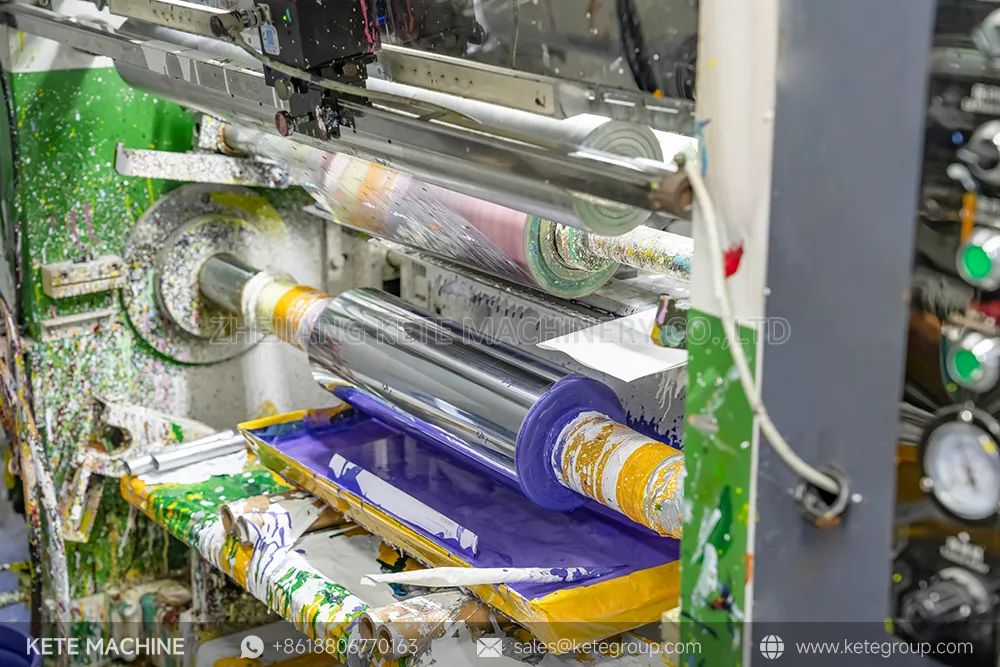
Every color in a gravure-printed design needs its own engraved cylinder. A six-color packaging job requires six cylinders — one each for cyan, magenta, yellow, and black, plus any special colors or coatings. This is the single largest upfront cost in gravure printing, and it is also why design changes after cylinder engraving are expensive: you are re-making metal cylinders, not swapping out polymer plates.
The process starts with image separation. The original artwork is digitally split into its component color layers, and each layer is converted into a pattern of dots matching the engraved cells on the cylinder. A steel base cylinder is first plated with copper — typically 150–200 μm thick for electromechanical engraving — to create the workable surface into which cells are cut.
Two engraving technologies dominate modern production. Electromechanical engraving (EME) uses a diamond-tipped stylus that physically cuts cells into the rotating copper surface, with cell depths controlled by the oscillation of the stylus. Laser engraving (LE) uses a focused laser beam to ablate cells directly into the copper, achieving cell positioning accuracy below 10 μm. LE requires a thinner copper layer — roughly 95 μm versus 170 μm for EME — saving about 0.38 kg of copper per cylinder and reducing chrome consumption by roughly 0.024 kg per cylinder (Nature Scientific Reports, 2022). The trade-off: EME produces deeper, more robust cells for heavy ink coverage; LE offers higher precision for fine-detail work.
After engraving, the cylinder undergoes chromium electroplating — a layer 10–12 μm thick for EME cylinders or 6–8 μm for LE cylinders. The chrome layer is what makes the cylinder durable enough for production. Industry standards specify a Vickers hardness of 850–950 HV. Cylinders below 800 HV are typically rejected because soft chrome wears unevenly and causes banding defects. A properly chromed cylinder can run 150,000–200,000 linear meters before cell depth loss exceeds the 3 μm wear tolerance that triggers re-chroming. The steel base itself can be reused through multiple copper strip-and-replate cycles, giving it a service life measured in years rather than impressions.
The Printing Cycle: Inking, Doctor Blading, Transfer, and Drying
Once cylinders are mounted on the press, each printing unit cycles through four steps — and this cycle repeats for every color station on the line.
Step 1 — Inking. The engraved cylinder rotates through an ink pan, submerging the cell-covered surface in low-viscosity liquid ink. Gravure inks are characteristically thin — typically 17–18 seconds on a Zahn cup — because they must flow readily into cells that may be only 50 μm deep. Both solvent-based and water-based formulations are in active use, with water-based inks gaining share rapidly in response to tightening VOC regulations.
Step 2 — Doctor blade wiping. Immediately after the cylinder exits the ink pan, a flexible steel doctor blade scrapes across its surface with a slight oscillating motion. This blade removes all ink from the non-engraved areas — the smooth “land” between cells — while leaving ink inside the recessed cavities. The blade rides on the unengraved screen lines, which provide structural support to prevent the blade edge from collapsing into the cells. Blade angle, pressure, and oscillation speed are all critical parameters: too flat an angle causes hazing (ink mist in non-printing areas); too steep an angle accelerates blade and cylinder wear.
Step 3 — Ink transfer. The substrate — whether film, paper, or foil — is pressed against the inked cylinder by a rubber-covered impression roller applying 1–5 MPa of pressure. Through a combination of mechanical pressure and capillary action, the ink transfers from the cells directly onto the substrate surface. Many presses supplement this step with electrostatic assist (ESA), which applies an electrical charge to improve ink release from the cells — especially valuable for halftone areas on rough or porous substrates. One important exception: ESA cannot be used with metallic inks, which are electrically conductive.
Step 4 — Drying. The printed substrate immediately passes through a high-velocity hot air dryer before entering the next color unit. The ink must be completely dry — residual solvent or water would cause blocking (transfer to the back of the web in the rewind roll) and color contamination in subsequent units. Drying capacity is often the real speed ceiling on a gravure press: a machine rated at 300 m/min may run at 180–220 m/min in practice because the dryer cannot keep up at top speed with heavy ink coverage.
These four steps repeat for each color unit in sequence. Modern presses use automatic side and longitudinal register control systems to maintain alignment within ±0.1 mm across all color stations — a level of precision that becomes critical when printing fine text, barcodes, or registration marks for downstream converting operations.
Post-Print Finishing and Quality Assurance
After the final color unit, many gravure presses include inline finishing stations — varnishing, embossing, die-cutting, and sometimes foil blocking — that deliver a finished product off the end of the line without separate offline processing. This inline capability is a significant productivity advantage for high-volume packaging.
Quality control in gravure centers on a handful of measurable parameters. Color difference (ΔE) is typically held to ≤ 2–3 for brand packaging, measured by spectrophotometer against the approved standard. Print density is monitored continuously: a drop of more than 0.10 density units below the standard triggers investigation. Residual solvent levels are critical for food-contact packaging, with EU regulations capping total residual solvents at ≤ 10 mg/m². Each of these metrics depends on consistent cylinder condition, ink formulation, and drying performance. When any one variable drifts, the resulting defect patterns are usually recognizable to an experienced operator — mottle (uneven color), pinholing (failed ink film continuity), or streaking (visible lines from debris under the doctor blade).
Gravure vs. Flexo vs. Digital: Which Technology Fits Your Production?
No printing technology is universally superior. The right choice depends on three things: your typical run length, your quality requirements, and your budget structure. The comparison below is built around these three dimensions to help you assess which technology aligns with your production reality.
Print Quality and Consistency: Where Each Technology Leads
Gravure remains the quality benchmark for long-run, continuous-tone printing. Its engraved cylinder produces true photographic gradients — cell depth varies continuously, so tonal transitions are smooth rather than constructed from halftone dots. Flexography, by contrast, builds its image from raised dots on a flexible photopolymer plate. Flexo quality has improved dramatically — modern HD flexo with flat-top dot technology can achieve 200 LPI screening and is adequate for most packaging graphics — but it cannot match gravure’s native continuous-tone capability, and its dot gain is typically 5–10% higher. Digital printing (inkjet or electrophotographic) offers variable-data capability — every impression can be different — and has zero plate or cylinder cost, but its image quality ceiling and speed remain below either conventional process for long-run work.
| Quality Dimension | Gravure | Flexo | Digital |
|---|---|---|---|
| Continuous-tone reproduction | ★★★★★ | ★★★☆☆ | ★★★☆☆ |
| Solid ink density uniformity | ★★★★★ | ★★★★☆ | ★★★☆☆ |
| Fine text / line sharpness | ★★★★☆ | ★★★★☆ | ★★★☆☆ |
| Batch-to-batch color consistency | ★★★★★ | ★★★★☆ | ★★★☆☆ |
| Variable data / personalization | ☆☆☆☆☆ | ☆☆☆☆☆ | ★★★★★ |
Cost Breakdown: Tooling, Makeready, and Where Each Technology Pays Off
This is where the technologies diverge most sharply — and where many first-time buyers make expensive mistakes by fixating on purchase price rather than run-length economics.
Gravure’s cost structure is front-loaded. A single engraved and chromed cylinder can cost several thousand dollars depending on size, and a six-color job requires six of them. Setup and register adjustment add to makeready time — a full job changeover can take 30–60 minutes per color station. But once the press is running, the per-impression cost is the lowest of any printing technology. At hundreds of thousands of linear meters per cylinder set, the amortized tooling cost per unit becomes negligible. And the high running speed — 200–300 m/min commercial, 400+ m/min on late-model high-speed presses — delivers throughput that neither flexo nor digital can match.
Flexo occupies the middle ground. Photopolymer plates cost tens to low hundreds of dollars each, and CTP (computer-to-plate) equipment allows in-house production. Makeready times are shorter than gravure — modern presses with servo-driven impression setting can complete a full job change in minutes. Per-impression cost is higher than gravure at long runs but lower at short-to-medium runs. The economic crossover point between flexo and gravure typically falls in the range of 20,000–50,000 linear meters, though this varies with job complexity, color count, and regional labor and cylinder costs.
Digital printing has zero tooling cost — no plates, no cylinders, no makeready beyond file preparation. Its per-impression cost, however, is 3–10 times higher than conventional printing due to ink or toner consumption. This makes digital the clear winner for runs under roughly 1,000–5,000 linear meters and the clear loser above 50,000. In between lies a gray zone where the decision turns on turnaround time, variable-data requirements, and whether the job will repeat — amortizing tooling over multiple runs.
Sustainability and Future-Proofing: The Regulatory Picture
Environmental regulation is reshaping the competitive landscape between these technologies. Solvent-based gravure inks — the industry’s historical default — emit volatile organic compounds (VOCs) subject to increasingly strict caps in Europe, North America, and China. The shift to water-based gravure inks is accelerating: in China, water-based ink gravure machines accounted for 37% of the market in 2025 and are projected to exceed 50% by 2027, driven by new packaging printing atmospheric pollutant emission standards that took effect in mid-2025 (Sunny Machine News, 2026).
A separate regulatory concern is hexavalent chromium, used in gravure cylinder electroplating. The European Union’s REACH regulation has flagged hexavalent chromium compounds as Substances of Very High Concern, and the industry is actively researching alternative coatings — nickel-boron electroless plating shows promise, with hardness reportedly exceeding conventional chrome in laboratory trials. This is not an immediate operational problem for most converters, but it is a structural risk that anyone making a 10-year equipment investment should have on their radar.
Flexo has an easier sustainability story: water-based and UV-curable inks are widely available and proven, and platemaking is shifting from solvent-wash to thermal and water-wash systems. Digital printing eliminates VOC emissions entirely, though the energy consumption and consumable waste from toner cartridges and inkjet heads carry their own environmental footprint — a point that receives less attention than it deserves.
Where Gravure Printing Excels: Key Applications Across Industries
Gravure’s technical strengths translate into specific market applications. Understanding where it dominates helps clarify whether your production fits the technology.
| Application Area | Typical Substrates | Run Length | Key Requirement |
|---|---|---|---|
| Flexible packaging (food, beverage, personal care) | BOPP, PET, PE, aluminum foil, laminates | Very high | Color consistency + food-grade safety + substrate versatility |
| Labels (beverage, spirits, personal care) | Paper, film, metallized paper | High | Fine text + metallic inks + scuff resistance |
| Décor printing (wallpaper, flooring, wood-grain) | Paper, PVC film | Very high | Color fidelity on reprints + wide width |
| Folding cartons (tobacco, cosmetics, pharma) | Paperboard | High | High line screen detail + brand-color precision |
| Publication (magazines, catalogs) | Lightweight coated paper | Very high (declining) | Speed + low per-copy cost |
| Functional printing (electronics, solar cells) | Specialty films, glass | Low (high value) | Precision patterning + material compatibility |
Flexible packaging is gravure’s largest market by far — accounting for an estimated 60–70% of all gravure printing volume — because food and beverage brands demand the color consistency, substrate range, and food-safe ink options that gravure delivers at scale. At the opposite end of the spectrum, publication gravure is in terminal decline as magazine and catalog volumes shift to digital media. The emerging growth story is functional and industrial printing: gravure’s ability to pattern conductive inks, dielectrics, and other functional fluids onto flexible substrates at high speed is attracting R&D investment in printed electronics, flexible solar cells, and smart packaging.
What to Consider When Investing in Gravure Equipment
Buying a gravure press is not buying a machine — it is investing in a production capability that will shape your cost structure, product quality, and competitive position for the next 5–10 years. An under-specified dryer or an over-specified color count are mistakes that compound year after year in the form of production bottlenecks, excess waste, or wasted capital. Smart purchasing starts with two questions: what do you actually need the machine to do, and what will it truly cost over its working life?
Matching Machine Specifications to Your Production Needs
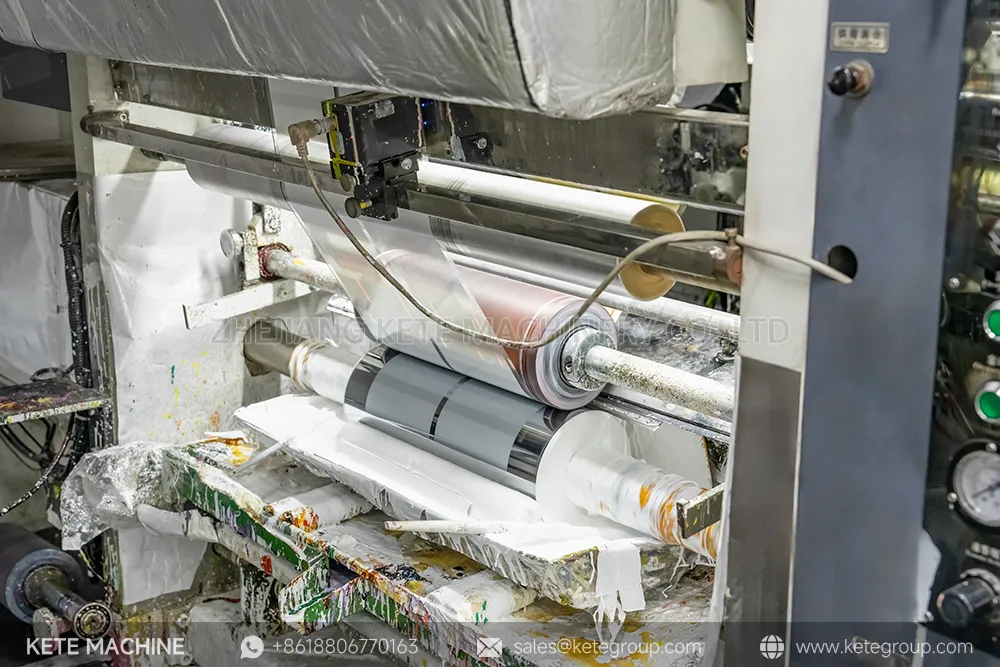
The most common — and expensive — specification error in gravure purchasing is over-buying color stations while under-specifying drying capacity. A 10-color press with an undersized dryer will run slower than a well-balanced 8-color press. The bottleneck is not how many colors you can print but how fast you can dry them between stations.
Start with your actual product mix, not your aspirational one. Printing width should match the maximum substrate width you run regularly, with perhaps 100–200 mm of margin. Common widths are 600, 800, 1,000, and 1,200 mm, with wide-web presses going to 1,500 mm and beyond for décor and industrial applications. Color stations should equal your most complex current design plus one or two for future flexibility and special colors or coatings. A typical flexible packaging operation needs 6–8 colors; adding stations beyond that drives up the machine cost, the cylinder inventory cost, and the makeready time without necessarily adding throughput.
Speed rating versus actual throughput trips up even experienced buyers. A press rated at 300 m/min will rarely sustain that speed in production. Real-world throughput depends on drying capacity, substrate characteristics, and ink coverage, and typically settles at 60–75% of the rated maximum. The dryer, not the drive motor, is the real speed governor. When evaluating specifications, compare the drying system’s rated evaporation capacity (kg of solvent or water per hour) against the ink coverage and speed you actually need — not the headline speed on the brochure.
Registration accuracy requirements depend on what you print. For block-color packaging graphics, ±0.3 mm is often acceptable. For fine text, barcodes, or security features, ±0.1 mm is necessary, and the press needs servo-driven longitudinal and lateral register control to hold that tolerance through speed changes. Ink system choice — solvent, water-based, or UV — has downstream implications for dryer configuration, exhaust treatment (RTO or solvent recovery), and regulatory compliance. If you anticipate a shift toward water-based inks during the machine’s service life, the dryer needs enough thermal capacity to handle water’s higher latent heat of evaporation.
Substrate range is easily overlooked: confirm the press can handle your thinnest film and your thickest board, and that the tension control system can maintain register across that range. A press optimized for 12 μm PET film may struggle with 300 g/m² paperboard unless the tension zones and impression settings are designed for both.
Total Cost of Ownership: Look Past the Purchase Price
The invoice price of a gravure press represents only a fraction of what you will spend on it over its working life. A disciplined TCO model separates the visible from the invisible.
One-time costs include the machine itself, installation and commissioning (which can run 5–15% of the machine price depending on site preparation and whether the supplier sends engineers for on-site setup), the initial set of engraved cylinders (multiply per-cylinder cost by color count by the number of SKUs you plan to run), and operator training. Annual operating costs break down into ink consumption, energy (the drying system accounts for 60–70% of total press energy consumption), consumables (doctor blades, impression roller recovering, filters), and cylinder reconditioning. Cylinders typically need re-chroming after 150,000–200,000 linear meters, and the steel base can be reused through multiple re-plating cycles. Solvent-based inks are cheaper per kilo but incur VOC compliance costs; water-based inks cost more per kilo but eliminate solvent handling and may reduce insurance premiums.
The hidden costs are what separate profitable installations from financial disappointments. Job changeover time — 30–60 minutes per color station — directly reduces available production hours. On a press running many short jobs, changeover can consume 20–30% of total scheduled time. Waste rates during startup and job change: new presses typically run 5–10% waste during the stabilization period after installation, and even mature operations see 2–5% setup waste per job change. Skilled labor availability is a growing concern industry-wide — experienced gravure operators and color matchers are in short supply — and the cost of recruiting or training them should be factored into the investment case.
As a rough illustration: over three years on a mid-range 8-color press, the purchase price might account for roughly 40% of total costs, with cylinders and reconditioning at 20%, consumables and energy at 25%, and labor and downtime at 15%. The exact proportions depend on your product mix, run lengths, and local cost structure — but the pattern holds: the machine price alone tells you less than half the story.
- Changeover downtime — 30–60 min per color station, can consume 20–30% of scheduled time
- Startup waste — 5–10% during stabilization, 2–5% per job change even at maturity
- Skilled labor shortage — experienced operators and color matchers increasingly hard to find
If the thought of modeling all of these variables feels overwhelming, it helps to work with a supplier who has seen enough different production environments to guide the specification process. Some manufacturers — particularly those with experience delivering complete production lines rather than standalone machines — can help map your product mix to the right press configuration, including cylinder planning, dryer sizing, and operator training requirements. For example, a flexible packaging converter in Russia recently commissioned a full rotogravure-to-pouch production line — including printing, laminating, slitting, and pouch-making equipment — with the manufacturer providing installation supervision and operator training as part of a single coordinated delivery. This integrated approach reduces the coordination burden on the buyer and helps ensure that the individual machines are sized to work together as a system rather than as a collection of independently specified units.
The Future of Gravure Printing: Trends Shaping Your Next Investment
The gravure press you buy today will operate in an industry that looks different five years from now. Four trends are reshaping the technology landscape — and each has practical implications for your equipment decisions.

Intelligent automation is the most visible change on modern gravure lines. Electronic shaft technology — replacing mechanical drive shafts with synchronized servo motors — has reduced pre-registration time by roughly 50% and enables registration accuracy of ±0.1 mm. IoT-enabled sensors with machine-learning algorithms now achieve diagnostic accuracy rates above 95% for common failure modes. Factories that have adopted these systems report equipment utilization improvements of roughly 25% and on-time delivery rates rising from 85% to 98%. Digital twin simulation — creating a virtual press model to test new jobs before running physical material — is cutting new product development cycles by up to 30%.
The green transition is accelerating faster than many converters expected. Water-based ink gravure machines are the fastest-growing segment, with China’s market share projected to cross 50% by 2027. Regenerative thermal oxidizer (RTO) systems for solvent-based lines now achieve greater than 99% VOC destruction while recovering 40–50% of thermal energy for reuse in the drying system. The hexavalent chromium question — whether the industry’s standard cylinder coating will remain viable under tightening global chemical regulations — is unresolved, but the research pipeline is active. A viable alternative within this decade is a realistic prospect.
Asia as the growth engine is not a prediction — it is the current reality. China, India, and Southeast Asia collectively drive the majority of new gravure press installations, supported by rising consumer spending on packaged goods and the region’s historical preference for gravure’s fine-character reproduction quality. Chinese gravure machine exports reached $960 million in 2024, a 12.3% year-over-year increase, reflecting both the scale of domestic manufacturing capability and growing acceptance of Chinese-built equipment in markets across Russia, the Middle East, Southeast Asia, Africa, and Latin America.
Hybrid production models are gaining traction. Rather than choosing between gravure and digital, some converters are adopting a “long-run gravure + short-run digital” strategy — running repeat orders on gravure for the lowest per-unit cost while using digital for samples, small batches, and variable-data elements like QR codes or regionalized label copy. Modular press designs that allow interchangeable gravure and flexo trolleys on the same line are beginning to appear, giving converters the flexibility to route jobs to the most cost-effective process without dedicating floor space to separate presses.
None of these trends means gravure is going away. What they mean is that the gravure press you invest in today should ideally have the architecture to accommodate water-based inks, the sensor infrastructure to support predictive maintenance, and the modularity to integrate with digital or flexo units as your product mix evolves. A machine that locks you into solvent-only operation with mechanical-drive registration may look economical on the invoice but expensive on the five-year P&L.
The gravure printing process itself — the engraved cylinder, the doctor blade, the impression transfer — has not fundamentally changed in decades. What has changed is everything around it: how the cylinders are made, how the presses are controlled, how the inks are formulated, and how the production data is captured and analyzed. Understanding the process is the foundation. Building a production capability on top of that understanding — with the right equipment, the right supplier support, and a clear-eyed view of where the technology is heading — is what turns gravure from a fascinating printing method into a competitive advantage.