 EN
 RU
 ES
 FR
 AR
 PT
 IT
 ID
 KO
 TR
 DE
 VN
 TH
 IN
 JA
 ZH
 MS

A bag producer in Gujarat watched his best-selling product line become illegal with one government notice. Single-use plastic carry bags below a set thickness were banned overnight, and every customer call turned into the same question: what can you sell me now? The natural next step is to look for a biodegradable bag making machine. That is where the second surprise waits, because the search results are not showing one category of equipment. They are showing three different industries that happen to share a keyword.
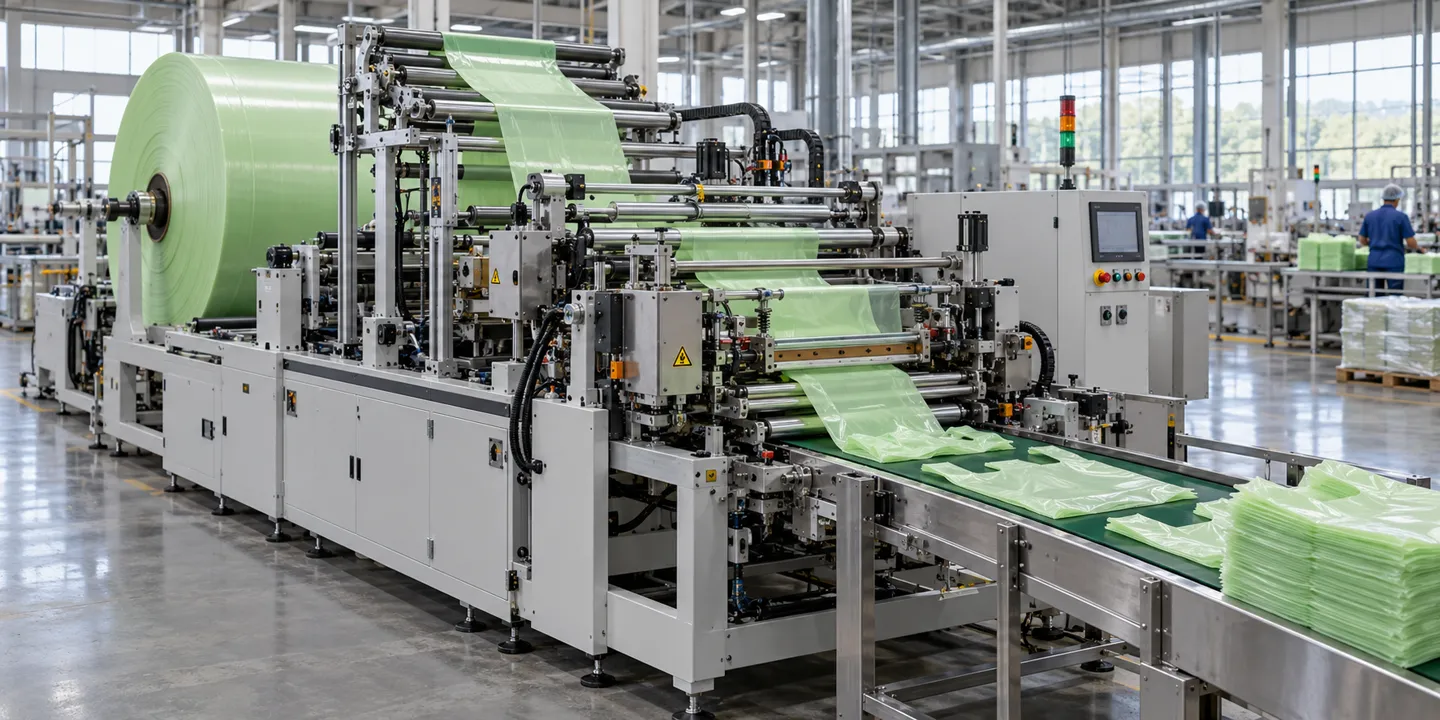
What “Biodegradable Bag” Actually Covers
The word “biodegradable” on a machine listing tells you very little on its own. Under that single umbrella sit two very different product families, and regulators treat them differently.
The first family is oxo-degradable plastic: conventional polyethylene mixed with additives that fragment it into smaller pieces. The European Union banned oxo-degradable plastic products outright under its single-use plastics directive (EUR-Lex, 2019), and most export markets have followed the same logic. Fragmenting is not composting. If your target market is the EU, the UK, or a growing list of cities elsewhere, oxo-degradable bags are not a product you can build a line around.
The second family is compostable material, certified against standards like EN 13432, which requires the bag to break down in an industrial composting process within a defined timeframe. When a retailer or a food chain says “biodegradable” in a purchase order, this certified family is almost always what their compliance team means.
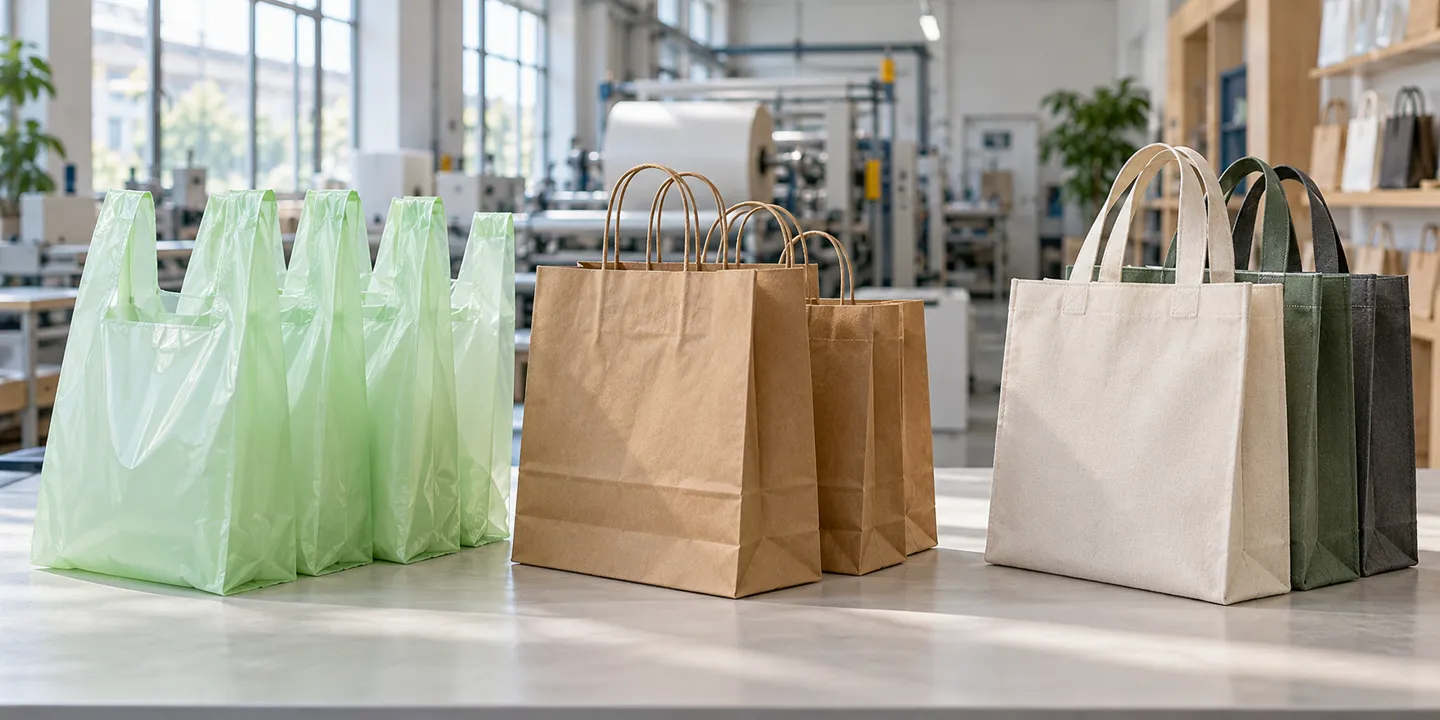
Then there is the equipment question. Bags that pass these requirements come off three types of production lines:
- Film route: bags formed from compostable resin blends such as PLA, PBAT, and starch mixes, on bag making machines descended from conventional plastic bag equipment
- Paper route: square-bottom, satchel, and carrier bags made from food-grade or kraft paper, on paper bag machines with separate handle-making units
- Non-woven route: reusable shopping bags cut and ultrasonically sealed from non-woven fabric rolls
These three routes share almost no machinery. A film bag machine cannot make a square-bottom paper bag, and a paper bag machine cannot seal a non-woven tote. This is the fact that the search results hide. Most manufacturers you will find are specialists in exactly one route. The ones selling “biodegradable bag machines” without naming a route are usually selling only the film version.
The rest of this article walks the three routes in the order buyers actually meet them. Then it shows how manufacturers differ, and where the money leaks out of a badly specified order.
The Film Route: Blends and the Machines That Run Them
Film is the route most converters look at first, because it is the closest cousin to the polyethylene production they already understand. The machines look familiar. The material is where the familiarity ends.
Why Nobody Runs Pure PLA or Pure PBAT
Newcomers routinely ask for “the PLA machine” or “the PBAT machine.” In real production, neither polymer performs well alone. PLA is too brittle for flexible films, while PBAT is too soft to hold a bag’s shape (UKHI). Commercial bags are therefore blown from blends, tuned along a simple trade-off: more PLA for stiffness and clarity, more PBAT for stretch and seal strength. Published film studies commonly work around even ratios, with one 2024 polymer-testing study locking its PLA to PBAT ratio at 1:1 (Polymer Testing, 2024). Starch-based fillers and compatibilizers sit on top of that base to pull cost down.
The economics have moved in the blend’s favor. Modern PLA-PBAT blends cost roughly 1.3 to 1.7 times the equivalent HDPE, down from about 2.5 times a few years ago (Bagmec). The blend is still more expensive than polyethylene, but the gap is no longer the wall it used to be.
What the blend now costs
1.3-1.7×
cost of the equivalent HDPE film
15-40%
retail premium behind a credible eco certification
8-20%
premium in B2B contracts
What the Blend Changes at the Machine
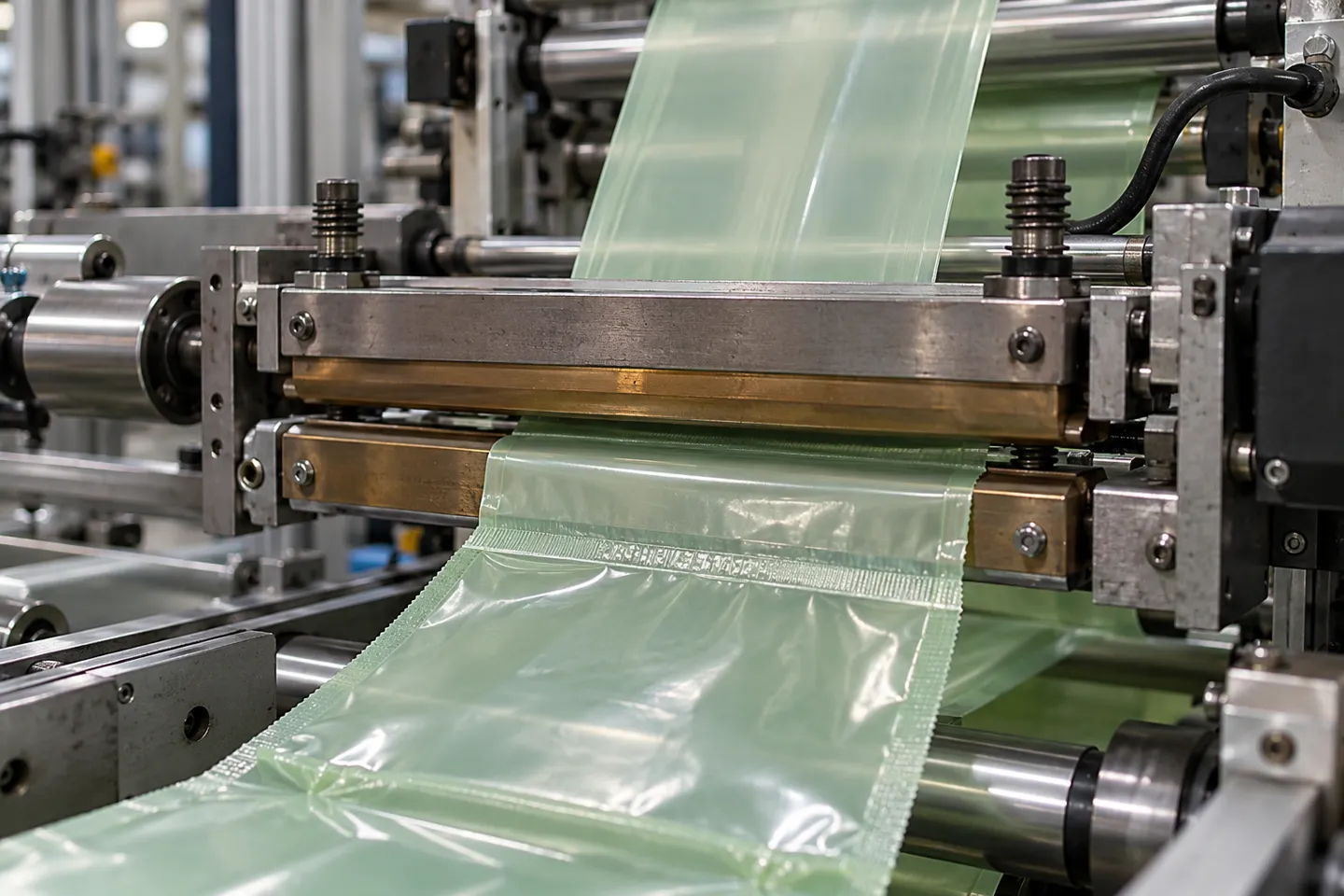
A blend that seals like PE and a blend that seals like PBAT are different machines on the same floor. PBAT’s melting range sits near 110 to 130 degrees Celsius while PLA melts around 170 degrees (PatSnap), so sealing bars calibrated for polyethylene do not transfer directly. Get the window wrong on compostable film and the seal either fails in transit or the film burns through.
Feeding is the second adjustment. Compostable film is more sensitive to web tension than PE. Pull it tight and it wrinkles; let it slack and the bag length drifts. This is why serious film-route machines run servo-driven feed with closed-loop tension control rather than a friction brake. When you read a spec sheet, the raw material row is the fastest tell. A machine that names biodegradable films among its supported materials has been engineered for this. A PE machine described as compatible “in principle” has not.
The Failure Modes You Inherit
Converting guides written for production floors document the same short list of film-route failures: bubble instability during blowing, die buildup, and sealing failures at the bag machine (WZASHAL, 2025). Each one maps to a machine capability, which is what makes the list useful when you compare suppliers.
Three film-route failures to ask about before you buy: bubble instability on the film line, die buildup at the extruder, and weak or burnt seals at the bag machine. Each has a machine-side answer: stable extrusion control, easy-access die maintenance, and servo tension with a sealing window tuned to your blend.
Trim waste is the quiet one. On a PE line, edge trim is scrap with a resale value. On a compostable line, offcuts are certified material you paid a premium for, so plants route the cut material back into the raw material flow instead of writing it off. Ask any supplier how their machine handles trim rewind, because the answer changes your real cost per bag.
Film Blend Cheat Sheet
| Blend | Character | Best For | Watch Out |
|---|---|---|---|
| High PLA | Stiff, clear, brittle edges | Carrier bags needing shape | Cracks on folds and handles |
| High PBAT | Soft, stretchy, strong seals | Garbage bags, roll bags | Bags slump without structure |
| PLA+PBAT+starch | Balanced, cheapest per kg | Volume carry bags | Quality varies by compounder |
Paper, Film or Non-Woven: Where Each Route Wins and Where It Breaks
Route choice is the decision that everything else hangs on. By the time UNEP and WRI reviewed the landscape in 2019, at least 127 countries had adopted some form of plastic bag legislation (WRI, 2019). Those bans keep arriving market by market. Choosing a route is partly choosing which policy wave you want your production line to ride.
The three routes are not three versions of the same business. They are three incompatible production systems with different economics:
Three Routes at a Glance
| Route | Typical Bags | Entry Equipment | Where It Breaks |
|---|---|---|---|
| Film | T-shirt, garbage, roll bags | One servo bag making machine | Price war on near-identical bags; depends on certified resin supply |
| Paper | Grocery, food, retail carriers | Square-bottom machine plus handle units | Slower rated speeds; paper weight and supply decide your ceiling |
| Non-woven | Reusable totes, laminated shopping bags | Ultrasonic cutting and sealing machine | PP non-woven is not compostable and rPET is recycled, not biodegradable; cannot be sold into compostable mandates |
Three facts inside that table deserve a closer look. The film route has the lowest entry cost and the fiercest competition, because one machine makes bags that look like every other machine’s output. The paper route carries the most natural “biodegradable” story, since paper needs no certification argument. Its machines sort by bag format and rated speed, from about 150 to 400 bags per minute depending on the model. The non-woven route sells reusability, which is a different claim than compostability, and honest producers keep the two apart in their marketing.
Three routes, three incompatible production lines: choose the wrong route and the correction is not one machine, it is the whole line.
Budget expectations scale the same way. A single servo bag machine sits in the low tens of thousands of dollars. A small complete plant starts around USD 50,000 (PAL-PLAS, 2025). A fully automated multi-line installation can exceed USD 500,000. The next section assumes you have picked a route and shows how to pin down the machine inside it.
The fact the search results hide
Three routes. Three machine systems. No shared equipment.
A wrong route cannot be patched. It is re-purchased as a whole new line.
Matching the Machine to the Bag You Actually Sell
Within one route, machines differ by the bag formats they form, the materials they accept, and the output they can honestly sustain. Here is how buyers work through the specification, route by route.
Film-Route Machines: Lines, Widths and Multi-Lane Output
Film bag machines are sorted first by bag style: T-shirt bags on sealing-and-cutting machines, flat bags on bottom-seal machines, garbage bags on heavy-duty frames. Working widths on the class run from roughly 600 to 1450 millimeters, with bag lengths up to 1500 millimeters. Speeds range from 30 up to 300 bags per minute depending on the model and material. The output multiplier is lane count: modern machines run one, two, or four lines of bags in parallel, with dual-servo control keeping lane lengths matched. On the spec sheet, again, check the raw material row. A machine that explicitly lists biodegradable films alongside HDPE and LDPE has tension and sealing parameters built for the blend, not just the polyethylene it was designed for.
Check a film machine against your blend
Send your bag size, film blend and target output, and we will confirm the sealing window, tension control and lane count that match it.
Send your film specPaper-Route Machines: Bag Formats and Handle Systems
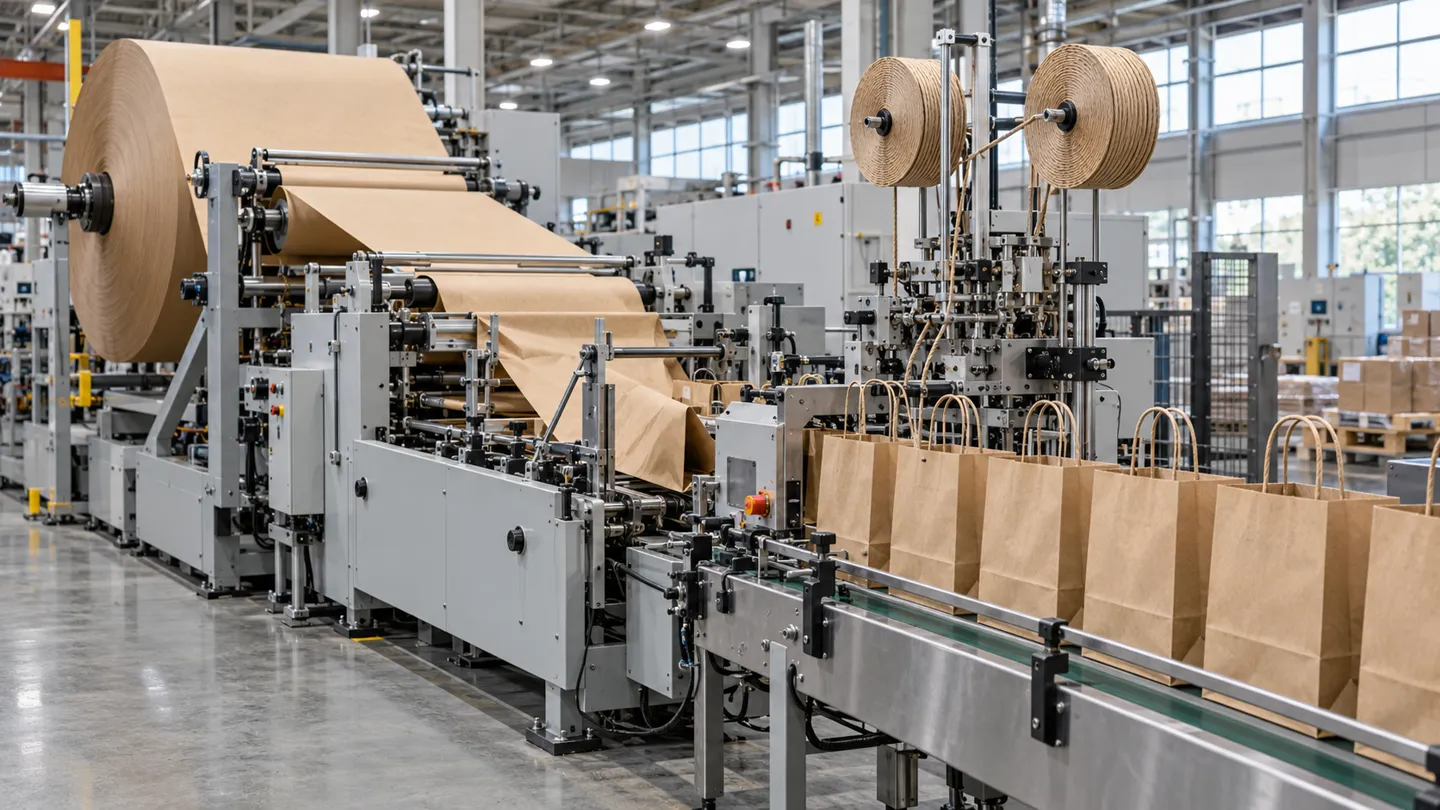
Paper machines sort by bag construction. Square-bottom machines make the self-standing grocery and retail carrier bags; satchel machines make flat food and pharmacy bags; window and double-layer variants cover premium retail formats. A representative mid-range model takes paper rolls up to 1500 millimeters in diameter and converts them into bags from 220 to 450 millimeters wide, with gussets from 80 to 220 millimeters. On that format it runs paper weights from 80 to 150 gsm at around 150 bags per minute. Faster models exist, and manufacturer series pages advertise up to 600 bags per minute. Treat that figure as a family ceiling rather than a model spec. Ask what a given machine sustains on your paper at your size.
Handles are their own equipment decision. Twisted-handle and flat-handle units are separate machines that make handle rope and patch, running at roughly 10,000 and 6,000 handle pairs per hour respectively. A bag machine with an inline handle station trades some speed for a shorter process. Inline two-color or four-color flexo printing, using water-based ink, can be added to certain paper bag models at print speeds up to 100 meters per minute. That removes a separate printing pass for simple logos.
Pouch and Non-Woven Formats
The pouch route serves brands that need stand-up and flat-bottom packaging rather than carry bags. Machines in this class handle three-side-seal, center-seal, stand-up, zipper, and eight-side flat-bottom formats from laminated roll stock. Feeding widths reach 1250 millimeters, and top speeds sit around 160 bags per minute. Non-woven machines cut and ultrasonically seal D-cut, T-shirt, and box bags from fabric rolls, typically in the 60 to 120 bags per minute range. There is no thread and no heat-seal margin.
Specification Benchmarks by Route
| Parameter | Film | Paper | Pouch | Non-woven |
|---|---|---|---|---|
| Speed range | 30-300 bags/min | 150-400 bags/min by model | Up to 160 bags/min | 60-120 bags/min |
| Working width | 600-1450 mm | 220-450 mm bag width | Up to 1250 mm feed | Model-specific |
| Key options | 1/2/4 lanes, dual servo | Handle units, inline flexo | Zipper, degassing valves | Ultrasonic sealing |
| Material row to verify | Biodegradable films listed | 80-150 gsm paper | Laminated structures | PP or rPET fabric |
One discipline ties all three routes together: confirm the model’s tested output on your material, at your bag size, before you compare prices. Series brochures quote ceilings. Machines rarely run at them.
How Bag Machine Manufacturers Actually Differ
Search results will hand you dozens of manufacturers, and at list level they look interchangeable. They are not. The market sorts into three layers, and knowing the layer explains most of the price gap.
A buyer can source a complete production line instead of coordinating three vendors. None of these layers is automatically the right answer. What matters is that you know which layer you are buying from, because each one fails differently when the wrong buyer picks it.
Three layers of manufacturer
Local assemblers
Components bought in, machines built to a price point.
Single-route factories
One product line engineered well and sold across markets.
Multi-route line suppliers
Two or all three routes, plus upstream printing, laminating and slitting.
The signals that separate layers are all checkable. Component brand is the fastest: motion controllers, servos, sensors, and web-guidance systems from named international brands cost more upfront and hold calibration longer. Factory testing is the second: whether the builder runs every machine through staged quality checks and a trial with the customer’s own material before shipment. Certification scope is the third: ISO 9001 covers the quality system, CE covers the machine for European markets, and neither says anything about the bags the machine produces.
Supplier verification checklist
Component list with brands for servos, PLC, sensors, and tension control
Written test procedure: which checks run before shipment, and with whose material
Trial-run video or witness visit on your own film, paper, or fabric
Defect-rate figures from the builder’s own production records
Warranty terms in years, and what voids them
Spare-parts list with prices, and shipping commitment
Delivery terms: FOB or DDP, and the delay penalty
Certification certificates by number, verifiable at the issuing body
Reference customers in your market segment
Who installs, trains, and answers the phone at 2 a.m.
Geography correlates with layers but does not decide them. Indian makers cluster in the low-to-mid film segment, Chinese export factories span every layer, and Taiwanese and European builders concentrate at the high end of specific routes. Treat geography as a prior, not a verdict, and let the checklist above score the actual supplier.
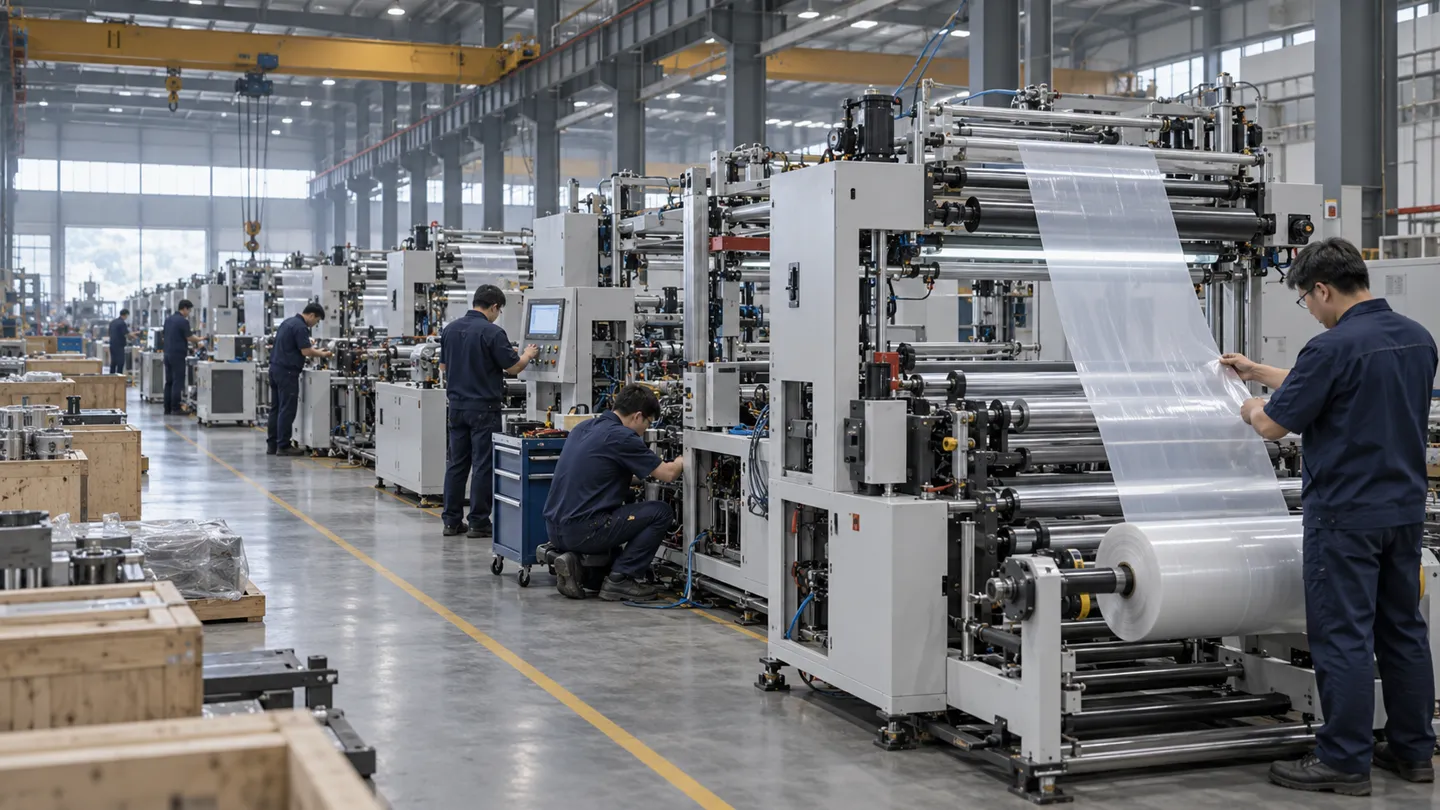
Cost, Certification and the Traps Between Them
Quotations for “biodegradable bag machines” arrive in incompatible units, and buyers who do not spot this overpay or under-buy. Three price conversations happen in the market at once. A single bag making machine in the general industrial class is quoted roughly between USD 5,000 and 45,000 depending on automation and build (KETE, 2026). A small complete production unit in India, including the film extrusion stage, is budgeted at about 60 lakh rupees (SolutionBuggy, 2023). A fully automated multi-line installation starts where the small plant ends and passes half a million dollars (PAL-PLAS, 2025). When one quote says 45,000 and another says 70,000, first check what the second one includes. Upstream extrusion, handles, printing, installation, and shipping explain almost every “expensive” quote.
The certification trap is quieter and costs more. A CE mark on a machine says the machine meets European safety directives. It says nothing about the bags. Compostable certification, EN 13432 or an equivalent, attaches to the material and the finished bag, and it is your resin supplier’s and your certifier’s domain. Even the certification itself has a boundary: a UNEP-hosted lifecycle review found that biodegradable bags only deliver their environmental benefit where composting infrastructure actually exists (UNEP Lifecycle Initiative, 2020). Selling compostable bags into a market without composting access is a promise your customer’s regulator may not accept.
Machine certification and bag certification are two different documents from two different processes. A supplier selling “certified biodegradable” machines is selling you a CE mark and hoping you will not ask about EN 13432.
Production economics hide three recurring costs after installation. Trim handling on a compostable line is a materials cost, not a waste cost, as covered earlier. Changeover between blends or bag sizes costs more on compostable film because tension and temperature need retuning. And the after-sales clock matters more on newer materials. A machine that sits down for a week waiting for a spare part erases the margin on a month of premium bags. Warranty terms in this market run from a standard one year to two years on selected models. Delivery terms range from 30 to 40 working days for standard machines to 60 to 90 days on DDP shipments. Write the acceptance test, the warranty start date, and the response commitment into the contract rather than trusting the quotation email.
What This Means for a Distribution Business
Every fact in this article re-reads differently if you are not buying a line but stocking one. For a distributor, the unit of this market is not the bag type. It is the route.
A customer who moves from film bags to paper bags does not add one machine. He replaces the line, because the routes share no equipment. That was true in the first section and it is the reason route coverage is a stocking decision, not a catalog detail. When a ban lands in one of the 127-odd legislating markets, a film-only catalog loses the account at the same moment a dual-route catalog wins it. Stock the film route for volume and the paper route for margin, keep non-woven as a complement, and quote its material boundary honestly: reusable, not compostable.
The same logic decides which upstream supplier deserves your shelf space. Multi-route coverage matters, and so does the line above the bag machine: flexo printing, laminating, slitting. A supplier who can deliver the whole chain converts your one-machine sale into a one-line sale and keeps the customer inside your catalog through every future route migration. We build for this pattern at KETE, where the catalog runs paper, film, and non-woven bag routes plus the upstream lines that feed them. Our film-side machines rate from 30 to 300 bags per minute, and our paper-side machines run 150 to 400 (paper bag making machines). Biodegradable films are named in the raw-material rows rather than left to assumption (bag making machines that run biodegradable films). Before any machine ships, our production floor runs it through staged quality checks and a full trial on the customer’s own material. Your reputation rides on that machine the same way the end user’s does.
That trial clause is the piece worth copying into your own supplier agreements, whichever upstream partner you choose. If you are mapping routes against your current customer base, a route-by-route machine comparison is the natural next step, and we are one catalog away.
Get a route-by-route machine quote
Paper, film and non-woven bag lines, plus the upstream printing, laminating and slitting equipment, from one supplier.
Request a machine quoteReferences
- World Resources Institute. “127 Countries Now Regulate Plastic Bags. Why Aren’t We Seeing Less Pollution?” 2019. wri.org
- UKHI. “PLA vs PBAT for Compostable Bags: Cost & Performance.” ukhi.com
- Chuakhao, S., et al. “The Crucial Roles of PBS Content and Reactive Extrusion in PLA/PBAT Blends.” Polymer Testing, 2024. sciencedirect.com
- PatSnap Eureka. “Polylactic Acid Biodegradable Film.” eureka.patsnap.com
- SolutionBuggy. “Start Biodegradable Plastic Bag Manufacturing in India.” 2023. solutionbuggy.com
- UNEP Life Cycle Initiative. “Single-Use Plastic Bags and Their Alternatives: Recommendations from Life Cycle Assessments.” 2020. lifecycleinitiative.org
- EUR-Lex. “Directive (EU) 2019/904 on the Reduction of the Impact of Certain Plastic Products on the Environment.” 2019. eur-lex.europa.eu