 EN
 RU
 ES
 FR
 AR
 PT
 IT
 ID
 KO
 TR
 DE
 VN
 TH
 IN
 JA
 ZH
 MS

A fully automatic paper cup machine listed at 120 pcs/min carries a price tag of $12,000-13,000 on one Alibaba listing (Alibaba, 2026). On IndiaMart, automatic models from Indian builders sit between ₹5.1 and 8.5 lakh, roughly $6,100 to $10,200 (IndiaMart, 2026). A machine buyer on Reddit quotes about $20,000-25,000 for a forming machine from PMC, a US brand (Reddit r/AskReddit, 2024). All three are sold under the same product name, and the gap between them is wider than the machines themselves.
That gap is the real subject here. Price lists answer “how much”. They cannot answer “for what”. Buyers who wire a deposit before understanding the difference are the ones who end up in troubleshooting groups, asking why their machine keeps rejecting cups. The sections below follow a careful buyer’s road: what the machine builds, where the price steps sit, what hides inside identical listings, and which quote lines deserve a fight.
What a Paper Cup Machine Actually Builds
One clarification first, because it pollutes a lot of price comparisons: a cup sealing machine, the counter-top device that sticks a film lid on a filled cup in a tea shop, is a different product entirely. If your results show small counter-top machines that seal a filled cup, that is a different product. This article is about the forming machine that turns a roll of PE-coated paper into finished cups.
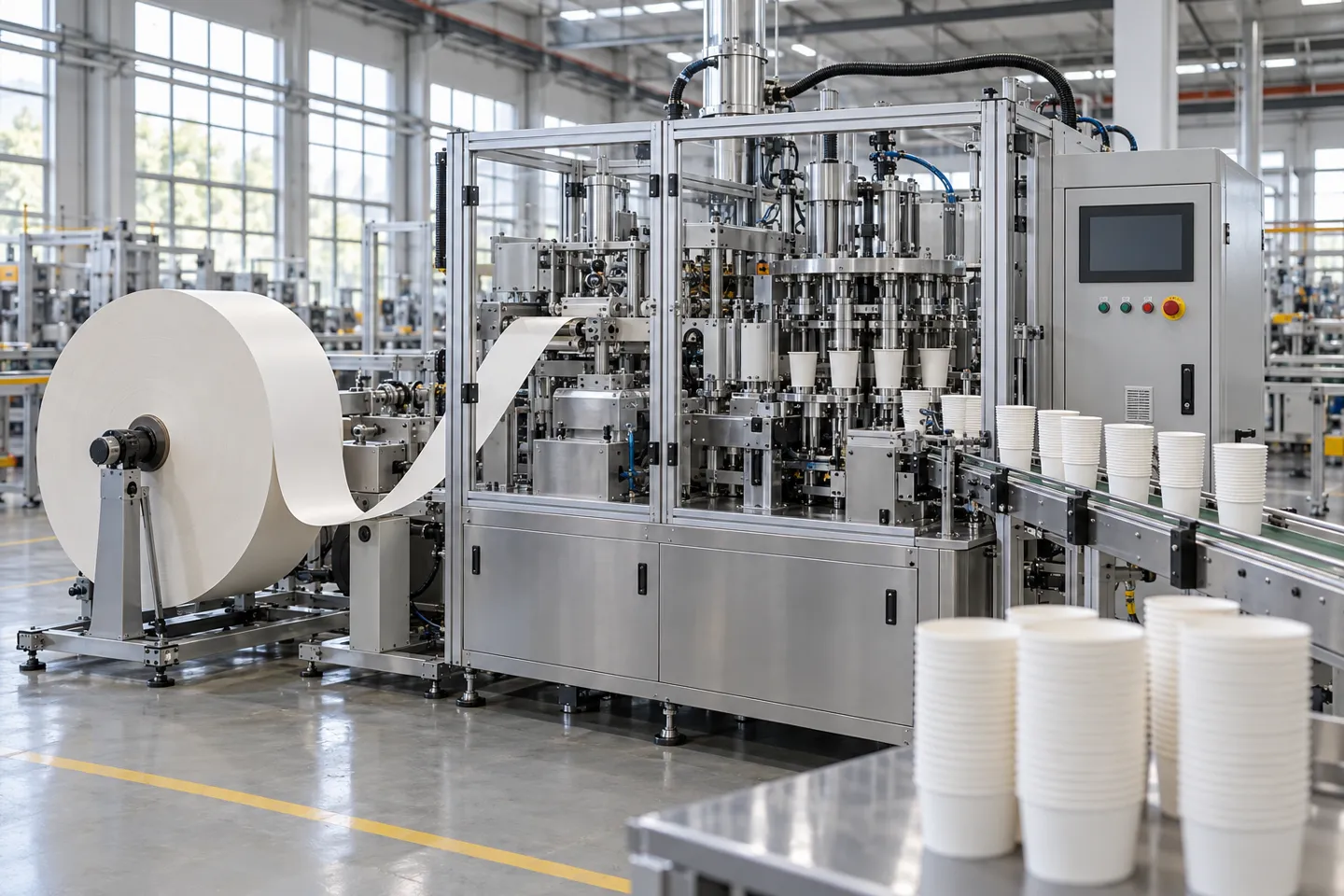
A paper cup forming machine runs a fixed sequence. Paper feeds from a jumbo roll through side-sealing, where the body tube is formed and its seam closed. A bottom disc is punched from a second roll and joined to the tube. Then the rim is curled and the finished cup is ejected. Machines for the food-service range commonly cover 65 to 300 ml, roughly 2 to 12 oz, with changeable molds. That range is the specification language sellers use when they ask what you want to produce.
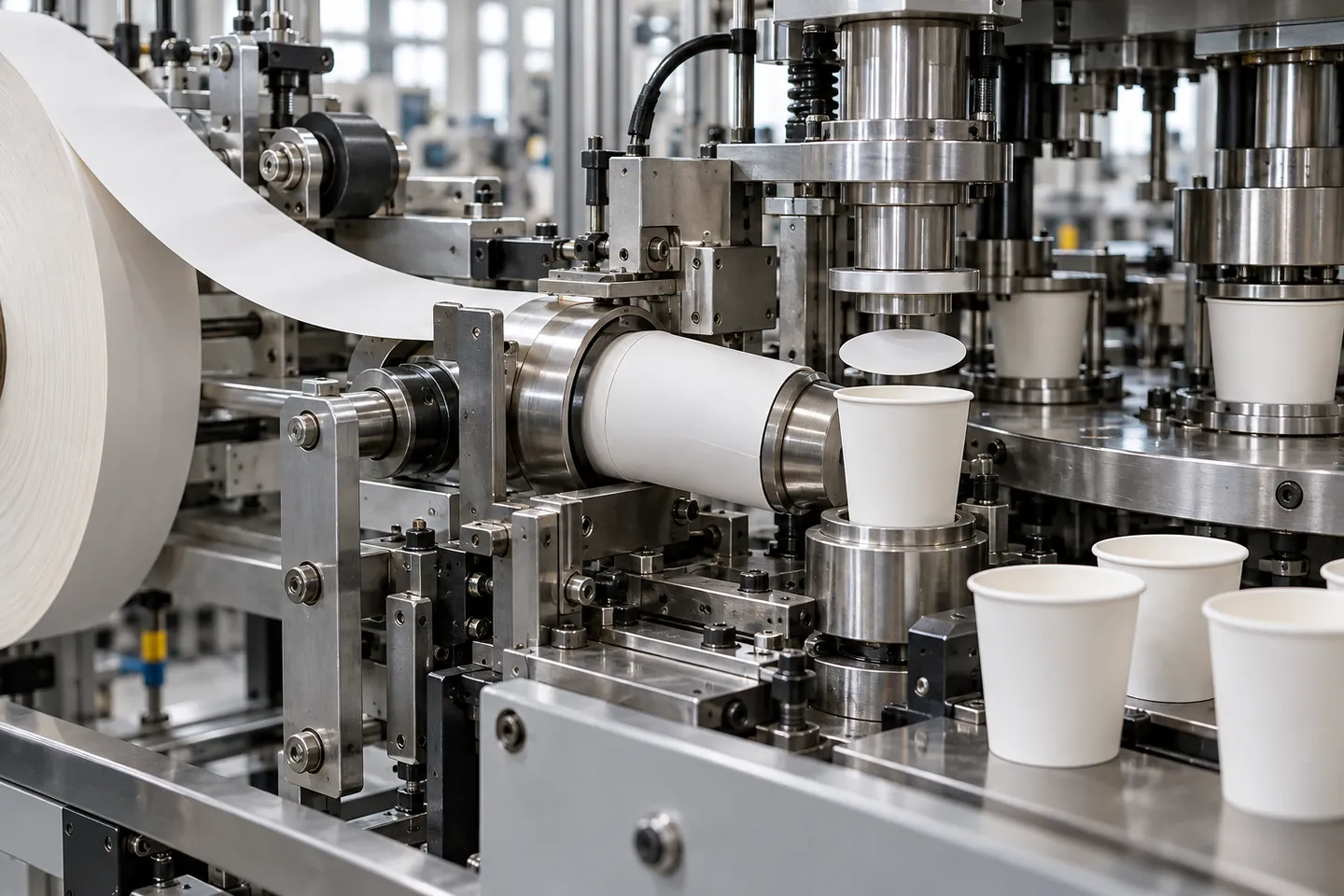
Nothing in that sequence explains a 3x price spread by itself. The sequence is nearly universal. What differs is how each step is built. Four choices set the price: what drives the motion, how the side seam is sealed, how many units the frame pushes per minute, and whose electronics sit in the control cabinet. Those construction choices are what you are actually paying for, and they organize the rest of this article.
Automation Levels and the Price Step Between Them
The first price step is the one every listing takes: automation level. Manual and semi-automatic machines leave some handling to people, typically loading blanks or unloading finished cups, and they exist because a small workshop can trade labor for capital. Fully automatic machines feed, form, count and eject on their own, and they start where the semi-automatic ones stop.
The published numbers sketch the ladder. Used machines on European marketplaces list around €6,000 and run 40 to 50 cups per minute (Machineseeker, 2026). New automatic models from Indian builders sit in the ₹5.1 to 8.5 lakh band, and Chinese export listings for 120 pcs/min automatics cluster near $12,000-13,000. When a Reddit buyer mentions $20,000-25,000 for a PMC forming machine, that is the production-grade end of the same ladder.
Automation levels and what they cost
| Level | Typical speed | Crew | Typical published band | What it fits |
|---|---|---|---|---|
| Manual / semi-automatic | 40-50 cups/min | 1-2 operators per machine | around €6,000 used; entry new units below $10,000 | sampling, tiny runs, learning the trade |
| Entry automatic | 90-120 pcs/min | 1 operator | ₹5.1-8.5 lakh on IndiaMart; ~$12,000-13,000 for a 120 pcs/min listing on Alibaba | steady single-size production for local supply |
| Production-grade automatic | 130+ pcs/min | 1 operator plus relief | $20,000-25,000 cited for PMC forming machines | contract supply, multi-size lines |
Platform listings and buyer discussions cited in References
The step between levels is not a feature fee. Each level changes the frame, the mold count and the crew you stop paying every month. If your plan is supplying cafes or a delivery platform rather than testing the waters, the entry-automatic tier is the real floor.
Within one automation level, though, prices still spread by thousands of dollars, and listings never explain why. That explanation lives in the hardware.
Why Identical-Sounding Machines Differ 3x in Price
Ask two sellers to quote “a 120 pcs/min machine” and the numbers will not match, because the specification you gave them hides four separate decisions. Each one is visible on an invoice if you know the words.
The drive system: cam-gearbox vs full servo
Entry machines time their stations with cams and a gearbox: reliable, proven, and slow to change over, because one mechanical timing chain serves every station. Servo-driven machines give each station its own motor. That costs more up front and pays back in changeover minutes, in steadier running at higher speeds, and in fault diagnosis, since a servo log tells you which station slipped. When a seller’s price is far below the band, the drive system is the first place the money was saved, and the first question worth asking in writing.
The sealing method: ultrasonic vs heat
The side seam and bottom join can be sealed with heated tooling or with ultrasonic horns. Heat sealing is the older, cheaper route and depends on consistent temperature and coating quality. Ultrasonic sealing costs more and holds up better with heavier coatings and at higher line speeds, and it leaves fewer burnt-edge rejects on the cup rim. Sellers who quote without naming the sealing method are quoting two different machines.
Speed tiers are different hardware, not a setting
A 150+ pcs/min machine is not a 90 pcs/min machine with the dial turned up. Higher tiers carry heavier frames, more mold stations, stronger motors and faster electronics, because the physics of forming a cup at 150 per minute is unforgiving. The spread in published speeds is a hardware ladder with a price step at each rung: 40-50 cups/min on used equipment, 120-130 on mainstream automatics, 150 and beyond on production machines.
The control cabinet: brands you can verify on the quote
Servo motors, PLC touch panels, photo sensors and web-guidance controllers carry brand names, and the brand tiers differ by a real margin. Schneider, Lenze, Delta, SICK, Yaskawa and Panasonic sit in published machine specifications across this industry, and a quote that lists them by name can be checked line by line. A quote that says “high-quality electricals” cannot.
Where the money goes: four configurations behind a price
| Configuration | Entry builds | Mid builds | Production builds | What it changes |
|---|---|---|---|---|
| Drive | cam-gearbox timing | mixed servo stations | full servo per station | changeover time, fault diagnosis, top speed |
| Side seam | heat sealing | heat sealing, better tooling | ultrasonic horns | reject rate at speed, coating flexibility |
| Frame and molds | single-size, light frame | 2-4 stations | multi-station heavy frame | cups per minute, mold life |
| Electricals | generic components | mixed brands | named brands (Schneider/Lenze/SICK class) | uptime, spare-part sourcing, resale |
Configuration patterns described in industry documentation; brand examples from published machine specifications
A fifth factor sits outside the machine: where the factory sits. Indian, Chinese and European builders serve different cost structures, and the price tag partly reflects service reach, spare-part logistics and documentation language rather than hardware alone. None of that is hidden, but none of it appears unless you ask what the number includes.
The fix is procedural, not technical: ask each seller to quote those four lines separately, in writing, at a named speed tested with a named cup size. Once quotes are aligned on configuration, the next question is what the aligned machine actually produces in a month.
$6,000 to $25,000+
Same product name. Same three words on the quote. The gap lives in four identifiable configurations: drive, sealing, speed hardware, electricals.
From Nameplate Speed to Real Output
What eats the nameplate speed
Nameplate speed is measured with everything going right: the right cup size, trained operators, consistent paper, no changeovers. A working month subtracts from it. Startups lose time to roll changes and jam clearance. Molds swap when orders switch sizes. Operators in machine communities spend threads on feeding faults as basic as paper tracking backwards until the guide wings are realigned (Facebook Groups, 2026). Industry maintenance guides list the recurring offenders: cup cracking at the seam, cups jamming between stations, feed rollers slipping, blades dulling, sensors drifting (Mingguo Machine, 2024).
A conservative output math
Here is an illustrative calculation, with numbers you should replace by your own conditions. Take the 120 pcs/min listing. Assume the machine runs effectively 70% of scheduled time once roll changes, minor jams and size changeovers are counted, and 95% of running output passes inspection. That yields 120 × 0.70 × 0.95, about 80 sellable cups per minute. An 8-hour shift then produces roughly 38,000 cups, two shifts across 22 working days land near 1.7 million cups a month. Run the same math on a 45 pcs/min used machine and the monthly figure falls below 700,000 cups, which is the gap between supplying a neighborhood and supplying a district.
The conservative math, nameplate to sellable
120 × 0.70 × 0.95 = nameplate × effective time × pass rate
~80
good cups per minute
~38,000
cups per 8-hour shift
~1.7M
cups per month, two shifts
Your actual factors depend on cup sizes, paper quality and operator training. Ask each seller for trial-run data with your own cup size.
The labor you stop paying
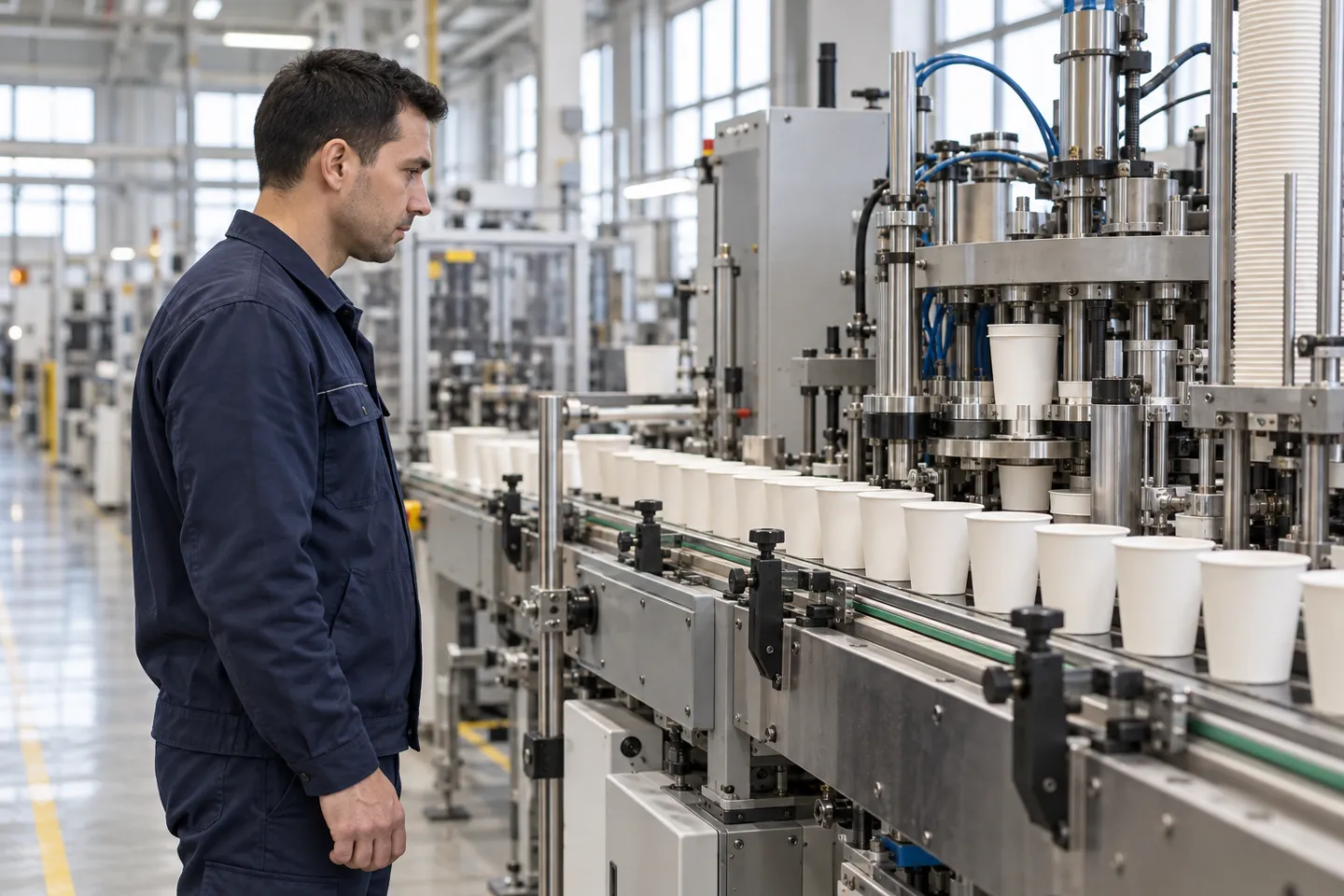
The other half of the speed purchase is payroll. Manual and semi-automatic tiers need hands at load and unload; a 120-130 pcs/min automatic runs with one operator watching a queue of cups leave the machine. Whether the upgrade pays depends on local wages and order volume. The arithmetic only works when the higher tier’s output is actually sold, which is why the next section matters more than the price gap itself.
The per-cup economics keep buyers honest. One small-business thread works it out plainly (Reddit r/smallbusiness, 2023). Cups retail around $0.09 each and cost about $0.04 to produce, leaving roughly $0.05 per cup before the raw-material supplier’s margin. Marketing guides that advertise 25-50% margins are describing the same arithmetic with better-looking inputs. Thin per-cup margins are exactly why effective output, not nameplate speed, decides whether a machine pays for itself.
Which tier fits which buyer
Configuration tiers: who they fit and when they stop fitting
| Tier | Fits | Monthly output reference | When it fails and you should upgrade |
|---|---|---|---|
| Used / manual / semi-auto (around €6,000) | sampling, tiny local runs, learning | below 700k cups (2 shifts, 45 pcs/min example) | regular contract orders arrive; quality claims start |
| Entry automatic ($6,100-13,000 band) | steady single-size supply to local cafes and delivery platforms | 1-1.5M cups (120 pcs/min example, 2 shifts) | order sizes multiply; changeover time becomes the bottleneck |
| Mid-speed automatic (120-130 pcs/min, named electricals) | district-scale suppliers, 2-3 cup sizes | 1.5-2.5M cups | volume contracts or export QC audits arrive |
| Production grade (150+ pcs/min, $20-25k class) | contract manufacturing, multi-size programs | 3M+ cups | niche only; idle capacity becomes the cost |
Tiers derived from published listings and buyer discussions cited in References; outputs are illustrative math, not promises
Read the matrix against your own order book, not against the biggest number you can afford. The right question is which tier your next 12 months of orders actually require, because the answer to that is the answer to what price you should be shopping for.
Reading a Quote Like a Buyer
Configuration tells you what to compare; the quote tells you whether you can trust the comparison. Export machinery quotes follow a recognizable life cycle, and each stage has terms that protect you only if they are written down.
If a quote is already sitting on your desk, send it over and KETE will mark the four configuration lines against it before you commit a deposit.
Request a Line-by-Line Quote ReviewStage 1, inquiry. Send your cup sizes, monthly target and shift pattern. Ask for the four configuration lines (drive, sealing, speed hardware, electricals) to be quoted item by item, with the speed stated as “tested with [your cup size]”. A seller who answers these in writing has already separated themselves from the platform-average listing.
Stage 2, contract and payment. Published export FAQs across this industry show a common structure (KETE FAQs, 2026). Buyers wire a 40% deposit to start production and pay the 60% balance before shipment, usually by T/T or L/C in USD or EUR. The protective details are the schedule and the inspection right, not the percentages themselves.
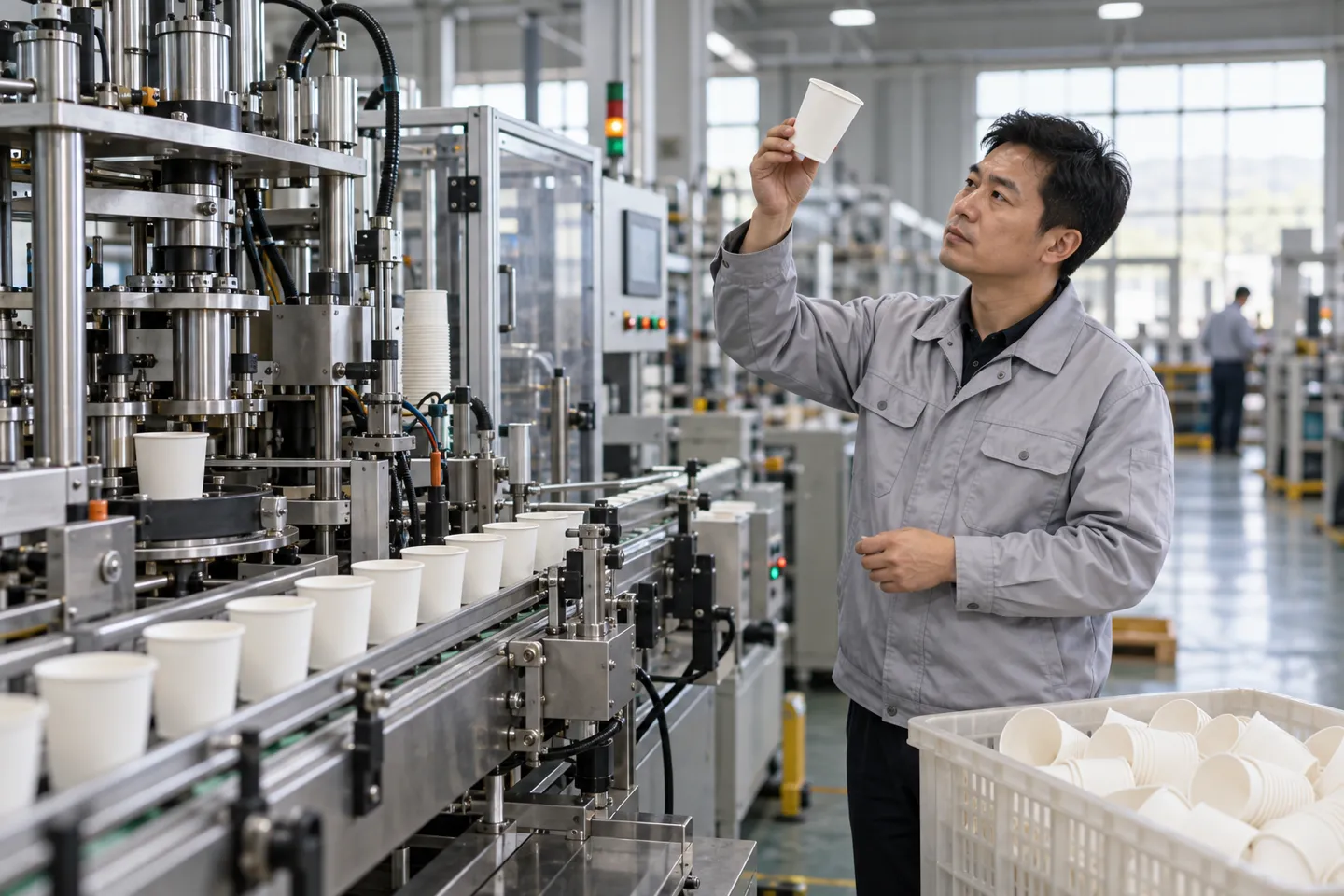
Stage 3, production and inspection. Serious builders send progress photos at defined milestones and invite inspection before the balance is paid. Video-call inspection is now standard practice; on-site visits and third-party inspection remain options for larger orders. Before shipment, the machine should be run with real material. The honest way to see it is a recording of that run, because a machine tested on your cup stock is worth more than any brochure.
Stage 4, shipping and landed cost. The machine price is not the landed price. FOB, CIF and DDP shift responsibility for freight and insurance, and import duties land on your side of the border in most structures. Packing should be fumigated wooden crates with anti-rust oil and desiccant, because a machine that spends six weeks at sea arrives as shipped, not as packed.
Stage 5, installation and after-sales. Warranty terms deserve a full reading (KETE FAQs, 2026). Minimum 1-year warranties starting from a signed installation acceptance are the published norm, and some builders extend to 2 years on specific models. The starter spare-parts kit should be listed, and the response window should carry a number: 24-hour feedback is the published standard. Non-standard factory voltage should trigger a free transformer, a published policy among export builders.
Quote checklist
- Four configuration lines priced separately (drive, sealing, speed hardware, electricals)
- Speed stated with test conditions and your cup size
- Payment schedule and inspection rights in the contract
- Progress photo milestones and pre-shipment run test with real material
- Shipping term (FOB/CIF/DDP) and duty responsibility named
- Fumigated crate, anti-rust oil, desiccant packing confirmed
- Warranty start point, spare-parts list, response window, voltage transformer policy in writing
A quote that survives this checklist is comparable. The remaining risks are the ones no checklist catches on paper, which is where the failures actually cluster.
Where Buyers Get Burned
The cheapest machine on the platform and the cheapest quote in your inbox share a habit: the cost comes back later. Manufacturer maintenance documentation lists the failure modes plainly: cups cracking at the seam, jams between stations, feed rollers that stop gripping, blades that dull, sensors that drift out of alignment. Operator communities handle the same failures in real time, down to threads about paper feeding backwards until guide wings are adjusted. None of this means the machines are bad. It means a machine at this price point assumes a competent operator and a stocked spares shelf, and both cost money the listing did not mention.
Used machines deserve their own arithmetic. A €6,000 used unit at 40-50 cups/min costs less than a third of a new mid-speed automatic. It arrives with worn molds, aged electronics and no warranty worth the word. The saving survives only if you can inspect, service and fix the machine yourself, which describes very few first-time buyers. If the budget only reaches the used market, the inspection conditions in the previous section stop being optional.
The third trap is the oldest one: a low quote achieved by redefining words. Speed quoted without test conditions, “servo” attached to one axis instead of all, electricals described as high-quality instead of named, these are configuration shortcuts wearing a discount. The buyer who aligned the four configuration lines before comparing prices is immune; the buyer who compared totals is the one these quotes are written for.
Before you wire the deposit
- A real-material run video, watched before the balance is wired.
- The spare-parts list checked against the crate, not against the email promise.
- Used machines: mold wear and controller age inspected first, warranty assumed absent.
Burns leave scars but also a pattern, and the pattern points somewhere: the market keeps rewarding the same behavior on both sides of the table.
What This Market Rewards
The market around this machinery is growing, quietly rather than explosively. Mordor Intelligence puts paper cup consumption at 5.41 million tons in 2026, reaching 6.41 million tons by 2031 at a 3.45% CAGR (Mordor Intelligence, 2026). Asia-Pacific holds a 39.10% share and grows fastest at 6.55%. The equipment side moves at a similar pace. Cognitive Market Research sizes the paper cup machine market at $1,754.3 million in 2025, reaching $2,292.28 million by 2033 at a 3.4% CAGR (Cognitive Market Research, 2025). Steady growth means steady entry of new buyers, and entry buyers arrive through the platforms where listings compete on price.
For distributors and resellers, that platform dynamic is the strategic fact. When 999+ listings compete under one product name (Alibaba, 2026), the lowest-price slot earns almost nothing and fields the most disputes. The buyer who chose purely on price is the buyer most likely to meet the failure modes described above. The margin lives one tier up: machines whose drive, sealing, speed hardware and electricals can be verified line by line, backed by delivery terms that are published rather than promised. Builders who publish their configuration standards, their warranty start points and their lead-time tables make that verification easy, and easy verification is what a reseller can resell.
That is where an integrated line changes the conversation, and where the printing step above cup-forming becomes the natural first purchase. KETE’s large-size paper flexo press for cup, bowl and straw stock runs four to six colors at a registered ±0.10mm. Webs run 620 or 820 mm wide at up to 50 m/min. Our stack-type paper printing machine is published specifically for paper bag and paper cup stock, so the same line logic covers the paper before it reaches the forming machine. We publish our lead-time table openly as well: standard converting machines run 30-80 working days by category and customized builds 90-120. That turns line planning into calendar work instead of guesswork.
The reward this market hands out, to buyers and resellers alike, goes to the party that turns price conversations into configuration conversations first. That habit is learnable, it costs nothing, and it is the difference between owning a machine and owning a working line.
Want to pressure-test your numbers against a real configuration? KETE quotes line by line against your cup sizes and shift pattern, and you can request an itemized quote online.
Turn Your Cup Sizes into an Itemized Quote
KETE answers with the four configuration lines, the speed test conditions and the lead time in writing, so your comparison starts aligned.
Get an Itemized QuoteReferences
- Cognitive Market Research. “Paper Cup Machine Market Report.” 2025. cognitivemarketresearch.com
- Mordor Intelligence. “Paper Cups Market Size & Share Analysis.” 2026. mordorintelligence.com
- Alibaba. “Paper Cup Machine Price: Country Search Listings.” 2026. alibaba.com
- IndiaMART. “Paper Cup Making Machine Product Listings.” 2026. indiamart.com
- Machineseeker. “Used Paper Cup Machine 6oz LBZ Listing.” 2026. machineseeker.com
- Reddit, r/AskReddit. “What Is the Best Paper Cups Machine and How Much?” 2024. reddit.com
- Reddit, r/smallbusiness. “Need Some Advice before Starting a Business.” 2023. reddit.com
- Facebook Groups. “Paper Cup Machine Operator Community.” 2026. facebook.com