 EN
 RU
 ES
 FR
 AR
 PT
 IT
 ID
 KO
 TR
 DE
 VN
 TH
 IN
 JA
 ZH
 MS

A $28 tabletop machine that seals ID cards in a school office and a $320,000 line that bonds food-pouch film on a converting floor share one name: laminating machine. Nothing in that name tells a buyer which one they need, and nothing in a price list explains the gap between them. The gap exists because the word covers four different machines for four different businesses.
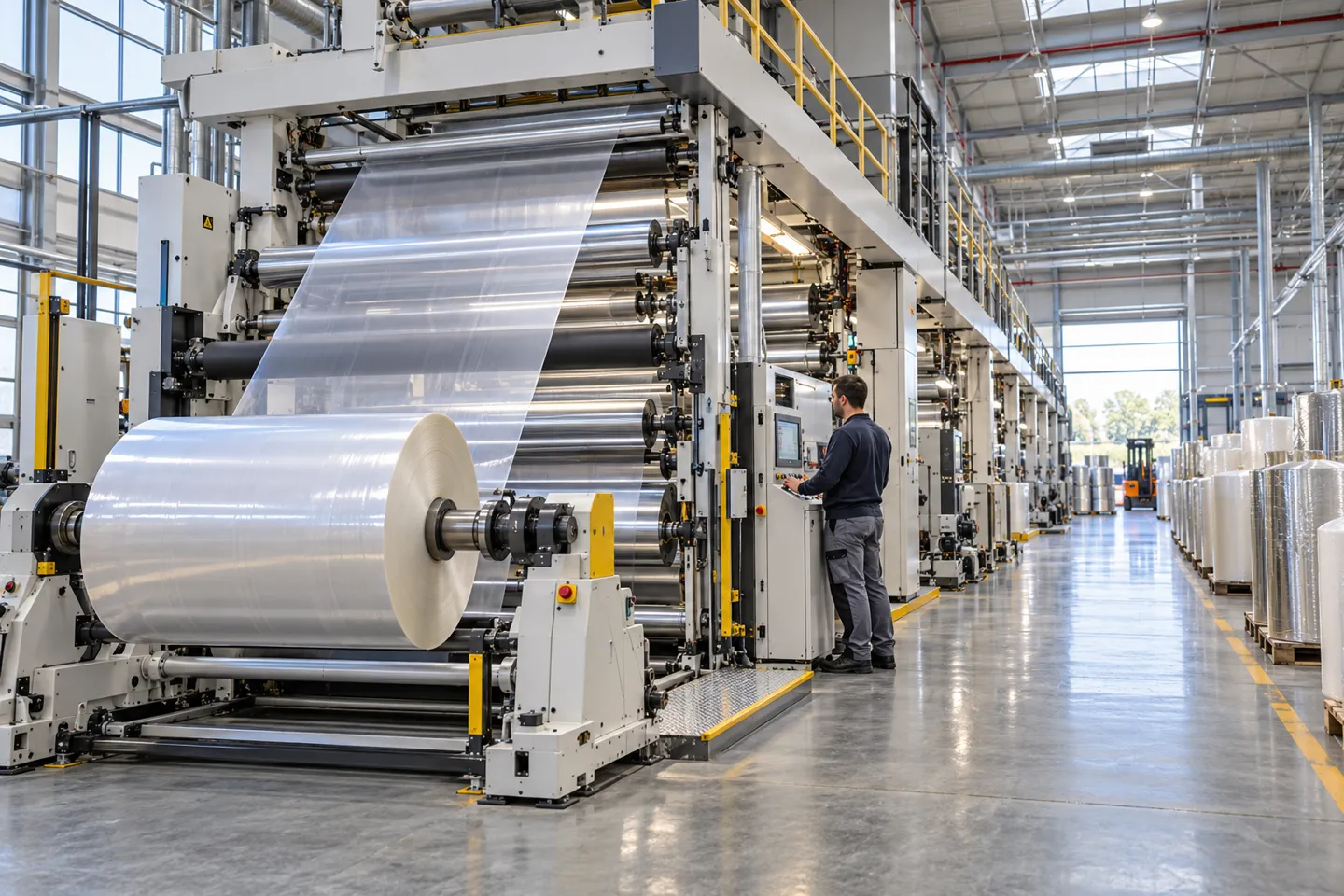
The machines differ in what they do to the material. A pouch laminator seals a sheet of paper between two layers of plastic so the sheet lasts longer. An industrial laminating machine bonds two or three functional materials, film to film, film to paper or film to foil, into one new structure. That structure is what gives a pouch its strength and its barrier. One machine protects a document. The other creates the packaging itself.
That difference shows up in the money. Across live retail and B2B listings, the same word spans four price tiers.
| Price tier | What the machine actually is | Typical live listings | The business it serves |
|---|---|---|---|
| $25 to $100 | Pouch laminator for sheets | Rated retail models listed at $28.49 to $97.90 (Target, 2026); mid-bracket consumer units near $79.99 (Creative Bloq, 2025) | Home, school, small office |
| $1,000 to $7,000 | Heavy-duty sheet, flatbed and cold-mount units | B2B wholesale listings currently show sheet systems in the $1,400 to $2,000 band and wide flatbeds around $8,200 (Alibaba, 2026) | Print shops, photo and poster work, light converting |
| $9,000 to $30,000 | Wide-format roll laminators for print and sign work | Dealer inventories of roll and pouch commercial machines (MidState Litho, 2026) | Commercial printing, sign shops, book covers |
| $20,000 to $320,000+ | Industrial converting laminators for packaging structures | Indian-market automatic solventless units around $19,500 (TradeIndia listings, 2026); Chinese storefronts list high-speed solventless lines at $105,000 to $125,000 and premium triplex verticals at $280,000 to $320,000 (Made-in-China, 2026) | Flexible packaging converters, bag makers, label and specialty converters |
If you buy in the first two tiers, this article is not written for you, and the price you see is close to the price you pay. From the third tier up, the number in the listing only starts the conversation. Everything that follows is about what that number hides, and how a converter or bag maker can take apart a quote before signing it.
What You’re Actually Paying For: The Specs Behind the Price
Two quotes for machines described in identical words can differ by a multiple. The difference is not mystery or margin alone. It is configuration, and every line of it is visible on the spec sheet once you know which numbers carry the money.
Mechanical speed vs laminating speed
Industrial spec sheets list two speeds side by side, and buyers who read only one of them overpay for speed they will never run. The mechanical speed is what the drives can do empty. The laminating speed is what the machine sustains while actually bonding your structure. Public spec pages for solventless lines show the pair together: 450 mechanical against 400 laminating on one series, 250 against 220 on an eight-motor dry laminator, 150 against 120 on an entry dry machine.
Quoting on the higher speed alone is where the margin conversation starts. The number that pays is the laminating speed, the one the machine sustains while bonding.
Web width and layer count
Width is priced in steps, not continuously. Packaging lines commonly run 1050, 1250 or 1350 mm webs, and the step you choose should match your order structure, not your fantasy of the largest order you might win. Layer count is a bigger jump. A two-layer and a three-layer solventless machine can share a spec table and a platform, as the public pages for both versions of the same series show. The third layer still adds a coating and bonding unit, and that unit is real money.
Tension control and drives
On thin films at width and speed, tension control is the difference between saleable rolls and a waste bin. Entry machines move the web with a shared drive. Higher-spec machines give independent motors to each section, the configuration usually described as eight-motor tension control, and public listings for the mid-tier dry laminator name it directly. This single line item explains more of the spread between two “similar” quotes than any other. It also explains failure: wrinkles, register drift and core crush trace back to it long before they trace back to the glue.
Oven and energy
A solvent-based dry laminator carries a drying oven, and the oven appears twice in your accounts. First in the machine price, where heated, temperature-sectioned ovens cost more to build. Then every month after, in the energy line. Solventless machines have no drying oven at all, which is a structural cost difference, not a tuning one. Public spec pages make the contrast easy to check. A dry laminator lists its oven temperature, in the region of 80°C on one published model. The solventless page lists nothing to heat.
Why nearly identical machines differ sixteen-fold
Listings in the same category currently run from about $19,500 for an Indian-market automatic solventless unit (TradeIndia listings, 2026) to $320,000 for a premium triplex vertical (Made-in-China, 2026). That is a sixteen-fold spread under one product name. The money buys layer count and top speed, the motors behind tension control, the automation at unwind and rewind, and how much of the line is engineered as one system.
The honest summary fits one sentence: the same machine name is quoted from about $19,500 to $320,000, and every dollar of that gap has a line item behind it.
| Spec pair to read together | What it tells you | Where it appears on public pages |
|---|---|---|
| Mechanical vs laminating speed | What you can actually run | 450/400, 250/220, 150/120 m/min |
| Web width steps | Order structure fit | 1050 / 1250 / 1350 mm |
| Layer count | Structure capability and price jumps | 2-layer vs 3-layer series |
| Tension system | Yield on thin film at speed | Eight-motor independent vs shared drive |
| Oven | Machine price and monthly energy | Listed temperature (around 80°C) vs none |
16×
Same product name, sixteen-fold spread
Automatic solventless laminators are publicly listed from about $19,500 (Indian market) to $320,000 (premium triplex vertical). Every dollar of the gap maps to a spec line.
Solventless, Dry or Extrusion: The Glue System That Sets Your Budget
The fastest way to waste money on a laminating line is to choose the machine before choosing the glue system. The glue system decides two budgets at once: what you pay on delivery day, and what you pay every month after. There are three ways to bond a packaging structure, and they are not interchangeable.
Solventless
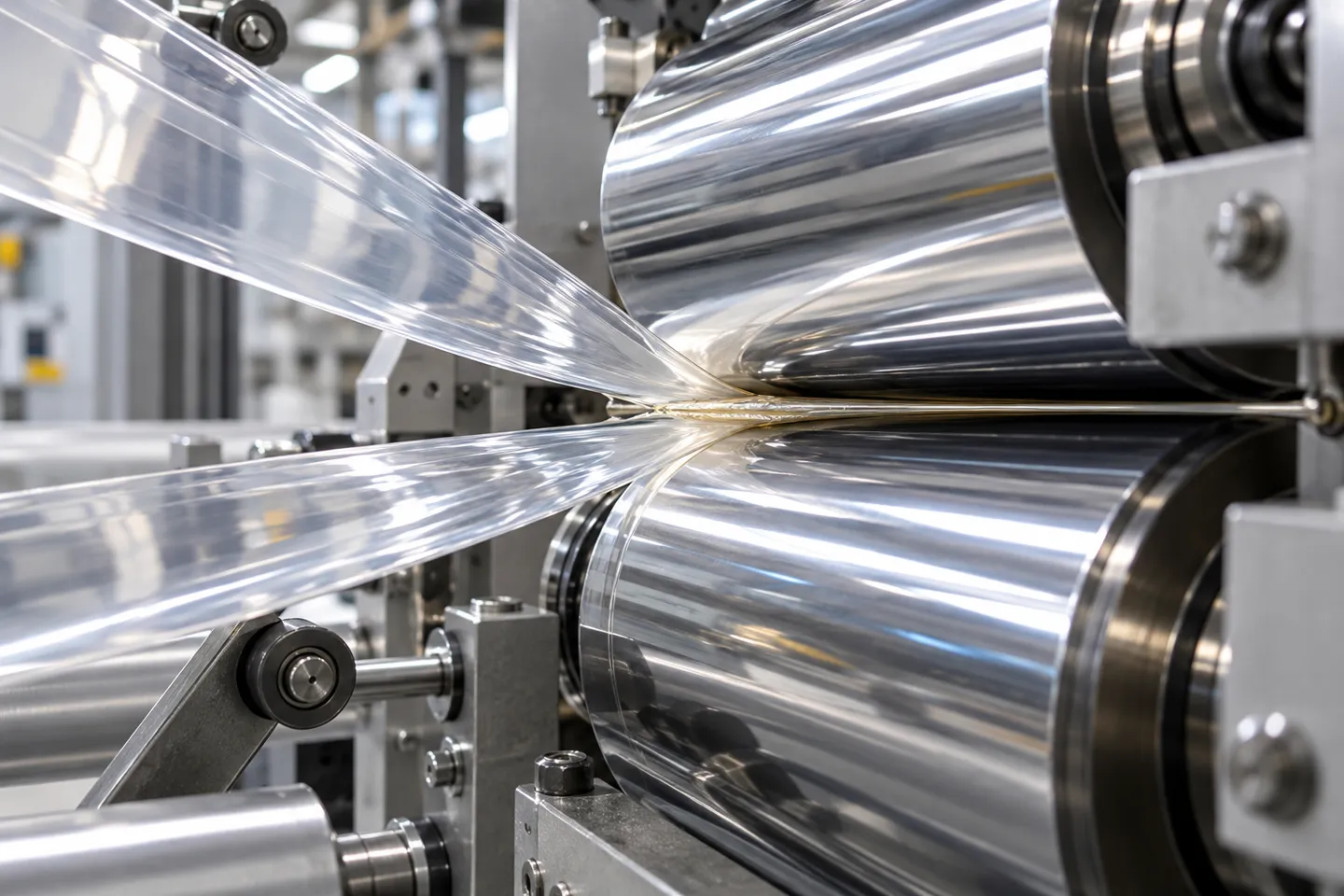
Solventless lamination bonds structures with a 100-percent-solids adhesive, applied in a layer measured in grams per square meter. Published machine pages list the working window at 1.0 to 3.0 g/m². There is no drying oven, so the energy account stays small, and there is no solvent to manage, which keeps the compliance conversation simpler in most markets. The trade-offs sit in chemistry and time. Adhesives cure after bonding, so finished rolls need staging time before conversion, and the working structure range is narrower than dry bonding.
Solvent-based dry
Dry lamination carries the adhesive through a heated oven before the bond is made. The oven is why these machines cost more to buy and more to run. Published models list oven temperatures in the region of 80°C and total power in the low fifties of kilowatts. What the oven buys is range. Heavy structures, paper to film, film to foil, structures that need aggressive bonding, are where dry lines still earn their keep. The management task is residual solvent: food and pharmaceutical buyers set limits, and your process has to hit them consistently.
Extrusion
Extrusion lamination replaces purchased adhesive with resin melted and extruded as the bonding layer itself. Published pages for extrusion lines list resins such as LDPE, PP, EVA and EAA, extrusion output around 260 kg/h, and applied film thickness from 0.01 to 0.11 mm. The adhesive purchase order becomes a resin purchase order; the cost moves and changes shape. Food and medical packaging use it heavily, and it bonds structures, film to nonwoven, film to paper, film to foil, that other systems handle differently.
| System | Fits these structures | Equipment price tier | Running cost driver | Fails when | Signal to switch |
|---|---|---|---|---|---|
| Solventless | Film to film, light film to paper, standard barrier builds | Mid to high on the industrial ladder | Adhesive grams per square meter, curing staging time | Structure needs heavy bond strength or foil-heavy builds; check your structure for foil layers before quoting | Orders shift toward heavy or foil-rich structures |
| Solvent-based dry | Paper to film, film to foil, heavy-duty builds | Mid, plus the oven premium | Oven energy every hour, solvent management | Residual solvent limits tighten in your end market; confirm limits before committing | Energy costs dominate and structures allow solventless |
| Extrusion | Film to nonwoven, film to paper, food and medical builds | High, plus resin handling | Resin price and extrusion output | Structure needs optical clarity or very thin bond lines; verify against target structures | Resin economics beat adhesive economics at your volumes |
The decision sequence that works is boring and reliable. Write down your structures, including every foil layer and every end-market limit. Let the structure pick the glue system, then let the glue system pick the machine. Doing it in reverse is how converters end up with a fast machine that cannot run their best-selling structure.
The decision sequence
1
Your structures
every foil layer, every end-market limit
2
Glue system
solventless, dry or extrusion
3
The machine
priced to run it
The Money Beyond the Sticker: Hidden Costs and How to Compare Quotes
Three quotes on the desk, three numbers that differ by tens of thousands, and no way to compare them. This is the normal situation in industrial lamination buying, because most of what you are buying is not printed on the quote. The fix is a comparison routine, and it has four steps.
First, normalize the columns. Put every quote into the same table: both speeds, width step, layer count, tension system, oven specification, roll diameter capacity. Public spec pages show what complete looks like, including 800 mm rewind diameters and 76 mm core sizes on standard lines. Blank cells in a quote are unanswered questions, and they cost more than they look.
Second, ask for the items that never print on the quote: installation and commissioning, operator training, the spare-parts and wear-parts list, response-time commitments, and the trial-run arrangement. After-sales support in this industry has a checklist of its own: installation, training, remote support and parts. Suppliers who publish that checklist are telling you what an unlisted quote omits (XIAOPAI, n.d.). Channel matters here too: factory-direct, dealer, B2B platform and used each produce differently shaped quotes, and the blank cells differ accordingly.
Third, run the monthly account. Take the glue system from the previous section and price its running line: adhesive by the gram, resin by the hour, oven energy where an oven exists. The machine price is one line in this account. Converters who compare only the machine price routinely buy the wrong first line.
Fourth, write verification into the contract. The trial run should use your material, your adhesive and your target structure, with video or an on-site witness, and acceptance metrics agreed in advance. Buyers in commercial print make the same discovery the hard way, and they say so publicly. First-buyer advice threads converge on the same rule: verify before you pay (Signs101, n.d.).
Quote comparison, four steps
Normalize spec columns: both speeds, width, layers, tension system, oven, roll capacity.
Demand the hidden items: installation, training, spare-parts list, response time, trial-run terms.
Run the monthly account: adhesive g/m², resin kg/h, oven energy.
Contract the verification: trial on your material, video or on-site witness, acceptance metrics.
The fastest quote to compare is one that already lists both speeds, the width step and the tension system.
Get a line-by-line quoteWhere Buyers Get Burned: Failure Modes and Pre-Payment Verification
The expensive lessons in laminating are not exotic. The same handful shows up again and again, and every one of them can be checked before the deposit leaves your account.
The first failure is tier mismatch, and it starts at the search box. A converter buys a $7,000 flatbed machine to run packaging structures. It cannot hold tension on a 1,300 mm film web, and expensive scrap follows. The check is unglamorous: match the machine class to the material structure first, price second.
The second failure is under-spec tension and heat. Thin film at speed on a shared-drive machine wrinkles; an undersized oven leaves residual solvent above the limit your food customer audits against. Both failures are preventable with two questions in writing: is tension control independent per section, and what does the oven hold across its sections.
The third failure is skipping the material trial. A machine that runs the supplier’s test film beautifully can still fight your adhesive and your laminate structure. Commercial-print buyers describe machines that ran for years without trouble, and they rarely credit the brochure (Reddit r/CommercialPrinting, 2024). The check: full trial on your materials, witnessed, before shipment.
The fourth failure is the support gap. The low quote that omits commissioning, training and parts support recovers its discount the first time the line stops and no one answers. The industry’s own after-sales guidance lists what must be delivered, which is another way of listing what missing support costs (XIAOPAI, n.d.).
Used equipment is the fifth way in, and it is legitimate. Second-hand laminators trade in real volume on used-equipment marketplaces, and they suit buyers with in-house maintenance capability. The inspection list grows longer, not shorter: tension system condition, oven and heater condition, and the spare-parts history. Without that capability, the discount is a loan against your first breakdown.
Five failures, five checks
Tier mismatch: match machine class to structure first.
Under-spec tension or oven: get drive and oven answers in writing.
No material trial: full witnessed trial before shipment.
Support gap: commissioning, training and parts named in the quote.
Used risk: inspect tension, oven and parts history, or walk away.
Running the Numbers Like a Business
Read the sixteen-fold spread again as a business document. It says that laminating machine price is not one number and never was. Two quotes that differ by a factor of three usually describe different machines, and only the normalized spec table can tell you which one you actually need.
The sticker is also only the first line of the account. The glue system you chose earlier decides the second line: adhesive by the gram, resin by the kilo, oven energy by the hour. A machine that costs more and runs cheaper is a common outcome here. The truth stays invisible unless someone runs the monthly account next to the purchase order.
Then there is the line around the machine. A laminator on a converting floor does not work alone. Printing feeds it, slitting takes its output down, and bag-making or pouch-making turns laminated film into sellable product. Buying the laminator as if it were standalone produces the classic result: a fast machine starved upstream and choked downstream. The line account, four stages, one throughput, is the real production math, and single-machine optimization is how capable factories stay slow.
The line account
Printing
feeds it
Laminating
one structure
Slitting
down to width
Bag-making
sellable product
One expansion note before the numbers close. Choose your speed and width steps for the orders you expect in three to five years, not the one on your desk this quarter. Capacity steps are bought once and lived with.
KETE holds itself to the same standard. We publish both speeds on our solventless lines, 450 m/min mechanical against 400 m/min laminating. Eight-motor tension control and sectioned ovens on the dry side sit in the same tables, because a quote you can verify line by line is the only kind worth comparing. The same pages carry our warranty terms: at least one year on every machine and two on selected models. Installation, training and round-the-clock support sit behind them (KETE laminating machines). Write the structures down and normalize the columns, and the machine that fits stops being the cheapest or the most expensive one. It becomes the one you can audit.
Want warranty, after-sales and delivery terms in writing next to the specs? KETE builds standard machines on 30 to 40 day lead times, and the full quality and support terms are published online (KETE quality).
Get a laminating quote you can audit
Send KETE your structures, width step and target speed, and the reply lists both speeds, the tension system and the warranty terms in writing.
Request a machine quoteReferences
- Creative Bloq. “The Best Laminators: for Home, School or Office.” creativebloq.com
- Target. “Laminating Machines.” 2026. target.com
- Alibaba. “Plastic Paper Lamination Machine.” 2026. alibaba.com
- MidState Litho. “Commercial Laminating Machines: Roll, Pouch and More.” 2026. midstatelitho.com
- TradeIndia. “High Speed Solventless Lamination Machine.” 2026. tradeindia.com
- Signs101. “New Laminator: Need Advice.” signs101.com
- Reddit r/CommercialPrinting. “Large Format Laminator Suggestions.” 2024. reddit.com
- MyBinding. “How to Choose a Laminator: Buyer’s Guide.” mybinding.com