ID
ID  EN
EN  RU
RU  ES
ES  FR
FR  AR
AR  PT
PT  IT
IT  KO
KO  TR
TR  DE
DE  VN
VN  TH
TH  IN
IN 
In industrial packaging, dimensional errors mean two things: immediate production downtime and catastrophic material waste. For procurement directors, plant managers, and supply chain engineers, “plastic bag sizes” are not merely numbers on a purchase order; they are critical engineering variables that dictate the efficiency of automated packing lines and the integrity of moisture barriers.
The core dilemma in this sector lies in a fundamental geometric friction: the mechanical challenge of containing a three-dimensional physical product or a rigid industrial vessel – such as a corrugated carton, a cylindrical steel drum, or a machined sub-assembly – within a two-dimensional, flexible polyethylene film. Attempting to convert volumetric requirements into flat dimensional specifications using visual estimates or colloquial terminology always leads to operational failure. When a 100,000-unit shipment of custom-printed poly liners arrives exactly 0.5 inches too narrow to clear the lip of a standard 55-gallon steel drum, the financial hemorrhaging begins instantly through halted assembly lines and the total loss of non-recyclable materials.
This technical compendium serves as the definitive manual for the modern packaging strategist. We will deconstruct the fundamental physics of film measurement, provide the rigorous mathematical formulas required to calculate dimensions for everything from flat apparel bags to complex bulk box liners, and expose the hidden sizing traps – such as material gauge displacement and tie-off allowances. We establish the universal language of measurement and decode the geometry of both 2D flat systems and 3D gusseted architectures.

The Fundamentals of Plastic Bag Measurement: The “Opening First” Law
To operate with authority in the global packaging market, one must first master the standardized syntax of flexible film dimensions. Miscommunication at the specification stage is the leading cause of procurement failure. In the industrial world, the golden rule of measurement is immutable: The first dimension provided in any specification string is always the opening (the Width), regardless of the bag’s orientation or whether that dimension is the longer or shorter side.
A specification listed as 12″ x 18″ represents a structurally and mechanically different product than an 18″ x 12″ bag. In the 12″ x 18″ format, the opening is across the narrow 12-inch side, creating a deep pocket typically used for vertical items like technical manuals or narrow metal rods. Conversely, an 18″ x 12″ bag features a wide 18-inch opening with a shallow 12-inch depth, optimized for wide, flat items like folded textiles or electronic components. Reversing these numbers fundamentally alters the Machine Direction (MD) and Transverse Direction (TD) of the film extrusion, directly impacting the load-bearing strength of the side seals versus the bottom seal.
The “Opening First” rule exists because of how high-speed bag-making machines are configured. The width of the bag corresponds directly to the width of the film web on the machine. If you specify the wrong dimension as the width, the manufacturer will set up the extrusion line for the wrong film width, resulting in a product that cannot be physically loaded by your automated systems.
To eliminate ambiguity in Requests for Quote (RFQs), internalize this four-axis glossary:
The measurement taken straight across the opening of the bag, from side crease to side crease, while lying flat. This represents the Transverse Direction (TD) and is the primary constraint for insertion clearance.
Also termed “depth,” this dimension follows the Machine Direction (MD) from the top of the opening to the bottom of the bag. It determines the total vertical capacity.
An engineered, expandable fold typically pushed into the sides or bottom. Measuring gussets requires unfolding the pleat to its full width (The “Open” measurement).
The thickness of the film (1 mil = 0.001 inches). While not a 2D dimension, thickness is a critical sizing variable because heavier gauge materials consume internal volume and resist folding.
Measuring 2D Packaging: Flat Bags and Reclosable Systems
Standard flat open-top bags and reclosable (zipper-style) bags are the workhorses of parts distribution, textile packaging, and clean-room document protection. However, calculating the correct size for a 2D bag requires accounting for the physical “arc” the film takes as it wraps around the product – a concept known as material displacement.
The Mathematical Formula for Flat Poly Bags
When you place a three-dimensional object into a flat bag, the object’s thickness pulls the width and length of the bag inward. If you use a bag that matches the exact flat dimensions of your product, the side seals will rupture the moment the item is inserted. To calculate the correct size, use the following industrial displacement formula:
Engineering-Grade Flat Bag Formula:
Required Width (W) = Product Width + Product Depth (Thickness) + Slip Fit Allowance (0.5″ to 1.0″)
Required Length (L) = Product Length + Product Depth (Thickness) + Seal Allowance (1.5″ to 2.5″)
Scenario: Consider a folded heavy-duty fleece jacket measuring 12″ wide, 15″ long, and 3″ thick. A novice buyer might order a 14″ x 17″ bag, assuming a 2-inch margin is sufficient.
The Math:
Required Width = 12 (W) + 3 (D) + 0.5 (Slip) = 15.5″.
Required Length = 15 (L) + 3 (D) + 2 (Seal) = 20″.
The 14″ x 17″ bag would cause immediate seam blowouts.
The “Usable Space” Trap in Reclosable Bags
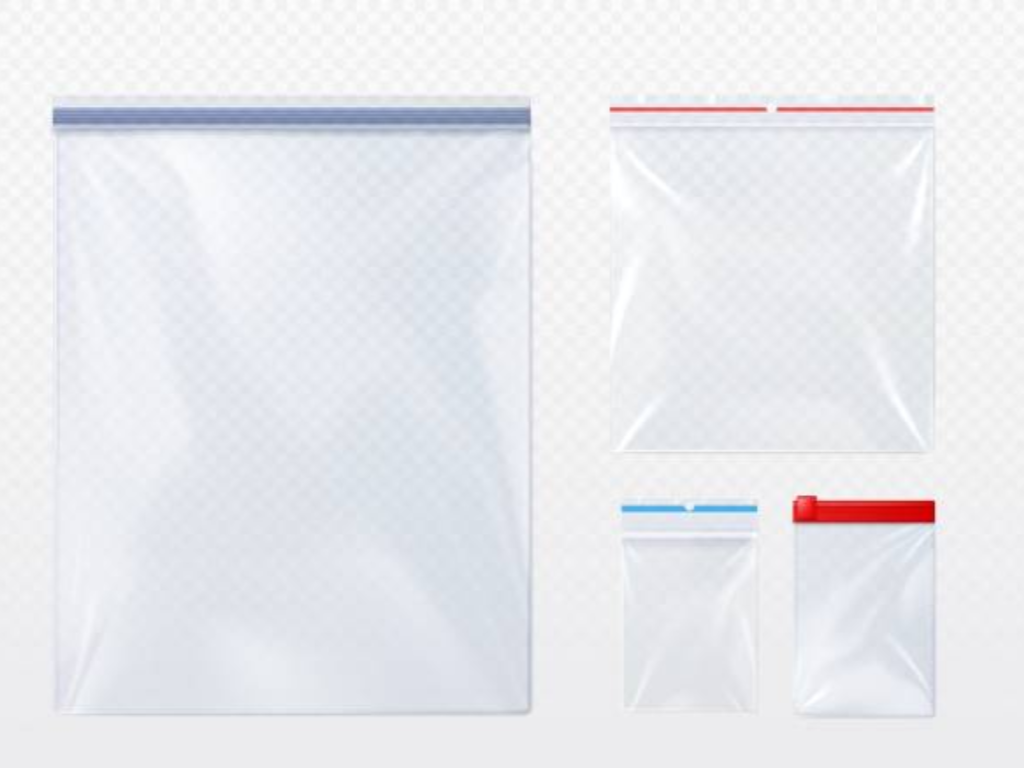
Reclosable zipper bags introduce a unique structural constraint: the zipper track and the top lip. The single biggest procurement error here is failing to distinguish between Overall Length dan Usable Length.
In the global standard, the specified length of a zipper bag strictly measures the distance from the bottom of the zipper track to the bottom of the bag. It does not include the “Lip” (the 0.5″ to 1.0″ area above the zipper). If you are packaging a 10-inch rigid metal component and you order a 10-inch zipper bag, the product will sit exactly flush with the zipper track, making it physically impossible to click the profiles shut. You must add at least 1 inch of clearance below the zipper to allow for the mechanical movement of the closure.
Decoding 3D Packaging: Side and Bottom Gusseted Bag Geometry
When the product profile moves from flat to voluminous – such as bulk coffee, industrial resin pellets, or cubic automotive parts – 2D bags become inefficient, causing unsightly “dog ears” at the corners and wasted material. Gusseted bags solve this by engineering pre-formed pleats into the film, allowing the bag to expand into a three-dimensional, box-like shape right off the production line.
Side Gusseted Bags
The W x D x L StandardSide gusseted bags are measured using three dimensions: Width x Depth (the Gusset) x Length. The Depth (D) is the most critical and frequently miscalculated variable.
The “Gusset” measurement represents the total width of the side fold when it is pulled completely open. To calculate this accurately from a flat bag, you must measure the width of the inward fold and multiply by two. For instance, if a bag has a 5-inch front face and the side fold goes in 2 inches, the correct specification is 5″ x 4″ x L. When filled, it transforms into a 3D rectangle with a 5″ x 4″ base, allowing for high-density palletizing.
Bottom Gusseted Bags
The Stand-Up Pouch LogicBottom gussets allow a bag to stand upright, essential for liquids and granular chemicals. The mechanical structure of a bottom gusset acts like the letter “W” at the base of the bag.
The operational danger here is optical shortening. When a bottom gusset expands to its full “Open Depth,” it consumes a significant portion of the bag’s vertical length. A bag measuring 12 inches long flat may only stand 9 inches tall once the base is pushed out. If your product requires a specific vertical clearance – for example, to accommodate a tall funnel or an automated filling nozzle – you must factor in this “loss” of length.
Box Liners Sizing Guide: Sizing Poly Bags for Square Cartons
While the gusseted bags discussed above are manufactured with a pre-engineered 3D structure, bulk industrial logistics often rely on a more cost-effective method: forcing a massive, inexpensive 2D flat bag to line a rigid 3D corrugated carton. Corrugated cardboard provides structural integrity but zero barrier protection against moisture vapor transmission or internal liquid leakage. The heavy-duty polyethylene box liner is the definitive engineering solution.
Calculating the exact flat dimensions of a flexible 2D bag required to perfectly line a 3D rectangular prism is a frequent mathematical challenge. If the liner is specified too small, it suspends the dense weight of the product above the carton’s floor. During transit vibration, this suspended film stretches aggressively, tears at the seams, and leaks. Conversely, surplus plastic folds over itself, creating overlapping creases that fail in automated heat sealers.
The Master Box Liner Formulas (2D to 3D Conversion):
Liner Width (W) = Box Width + Box Depth + 2 inches (for dimensional slack and corner fitting)
Liner Length (L) = Box Height + (Box Depth / 2) + Overhang (Typically 5 to 8 inches)
Box Depth / 2) specifically applies to standard Flat Bottom Liners, where the flat bottom seal must fold inward to physically cover the floor of the box. If you are procuring pre-formed Block Bottom Liners (Square Bottom Bags), the 3D base is already dimensionally formed at the factory. In that case, the length calculation simplifies dramatically: Box Height + Overhang.
Sandbox Simulation: The 18 x 12 x 14 Carton
Assume your facility needs to line thousands of standard corrugated cartons measuring exactly 18″ (Length/Width) x 12″ (Depth/Width 2) x 14″ (Height) with standard flat liners. Let us run the mathematics:
| Dimension Variable | Carton Measurement | Formula Application | Resulting Liner Dimension |
|---|---|---|---|
| Bag Width (W) | 18″ (W) and 12″ (D) | 18 + 12 + 2″ (Slack) | 32 inches |
| Bag Length (L) | 14″ (H) and 12″ (D) | 14 + (12 / 2) + 6″ (Overhang) | 14 + 6 + 6 = 26 inches |
The absolute perfect internal liner for an 18 x 12 x 14 box is a 32″ x 26″ standard flat poly bag. This precise mathematical conversion eliminates trial-and-error sampling, guaranteeing a flush fit that protects the box corners.
Drum Liners Sizing Guide: Sizing for Round Containers and Buckets
Massive segments of the chemical, agricultural, and industrial food ingredient sectors operate almost entirely with round containers – specifically 5-gallon high-density plastic pails and 55-gallon steel drums. Highly viscous liquids, industrial adhesives, and fine hygroscopic powders are exceedingly difficult to manage if they contact the interior walls of a reusable drum. Drum liners eliminate the immense operational downtime and environmental hazard of washing these containers.
Calculating the flat dimensions of a polyethylene bag to perfectly line a cylindrical drum introduces the geometric concept of circumference and the mathematical constant Pi (3.14). The challenge is determining how wide a 2D plastic piece must be to comfortably wrap around the circular interior without over-stretching.
The Master Drum Liner Formulas:
Liner Width (W) = (Drum Diameter x 3.14) / 2 + 1 to 2 inches (Clearance)
Liner Length (L) = Drum Height + (Drum Diameter / 2) + Overhang (Typically 5 to 8 inches)
The Industrial Sandbox Application: The typical internal dimensions of a standard 5-gallon bucket are approximately 12 inches in diameter dan 15 inches in height. If a procurement director guesses visually and buys a flat bag 15 inches wide, the bag will violently split at the side seams the moment an operator stretches it over the rim.
Applying the rigorous formula: Required Width = (12″ diameter x 3.14) / 2 = 18.84″. Adding a 1.16-inch clearance yields an ideal target width of exactly 20 inches. For Length: 15″ vertical height + (12″ diameter / 2 = 6″ to securely cover the bottom radius) + a 6″ top overhang = 27 inches. To avoid custom run MOQs, the savvy professional will universally source an off-the-shelf 20″ x 30″ drum liner, ensuring a stress-free fit with ample tie-off material.
The Hidden Sizing Traps: Thickness, Friction, and Tie-Offs
Even when a highly trained packaging engineer flawlessly executes the geometric formulas, catastrophic material failures can still occur. Mathematical formulas exist in a theoretical, frictionless vacuum, whereas plastic film exists in a highly variable physical world. Several silent “sizing traps” consume calculated volume in ways pure mathematics cannot predict.
Material Thickness (Mil/Gauge) Cannibalization
As the physical demands of the packaging application increase, required bag thickness often increases dramatically from standard 1-Mil up to 4-Mil, 6-Mil, or even 8-Mil profiles to prevent puncture during transit.
At 6 Mil and above, polyethylene film ceases to behave like a soft, yielding plastic bag and handles mechanically more like heavy canvas or rubber. Thickness cannibalizes usable internal volume. The sheer rigidity of the thick material requires significantly more physical space to bend, creating stiff “dead zones” at the bottom corners. If you use the exact same dimensional formula to buy a 1-Mil bag and a 6-Mil bag, the 6-Mil bag will effectively act as if it is 1 to 2 inches smaller in every direction. For heavy-duty bags (4 Mil and above), you must unilaterally add an extra 1 to 2 inches to both the Width and Length calculations.
Material Slip and the Coefficient of Friction (COF)
While physical dimensions dictate static volume, the dynamic act of packing introduces an invisible sizing variable: the Coefficient of Friction (COF). When polyethylene film is extruded, it naturally possesses a high tackiness (blocking). To combat this, extrusion engineers introduce microscopic slip additives, which bloom to the surface to act as a dry lubricant.
If your procurement team sources a custom film with a high COF (low slip additive), the interior walls of the bag will grip your product aggressively during insertion. A box liner that mathematically should fit perfectly will suddenly require immense physical downward force to push the product to the bottom floor. This traps massive air pockets and creates severe tension that frequently ruptures the extruded side seals. When specifying dimensions for high-velocity packaging operations, you must explicitly align your COF requirements with your dimensional tolerances.
The Manual Tie-Off Reality
In our Box and Drum formulas, we mandated adding 5 to 8 inches of “Overhang.” This excess length serves a critical mechanical purpose known as the “Tie-Off.” Many high-volume operations rely entirely on manual labor to close thick liners using wire twist ties or the “gooseneck” tape method to ensure a watertight seal.
To manually close a heavy bag, an operator must grab the top of the plastic, gather it tightly into a bundled cylinder (the “neck”), twist it securely, fold it over itself, and apply the tie mechanism. Gathering the plastic into a neck instantly consumes massive amounts of vertical length. If your bag length stops exactly at the top of the product inside the box, the worker has absolutely no leverage to gather the material. A minimum of 5 to 8 inches of dedicated Tie-Off length is a mandatory, non-negotiable tax on your total bag length specification.
Industry Manufacturing Tolerances and Strategic Supply Chain Upgrades
As you compile mathematically verified dimensions to submit to packaging suppliers, you must confront the final reality of the flexible packaging industry: absolute, millimeter-perfect precision does not exist in standard outsourced commercial production. The manufacturing of plastic bags is an intensely aggressive physical process involving melting polymer resins, high-speed extrusion, heavy nip rollers, and heated mechanical blades. This process inherently generates dimensional variations known as Manufacturing Tolerances.
However, what happens when your facility experiences dimensional variance that wildly exceeds these limits? The root cause of extreme, unacceptable tolerance variations is almost entirely dictated by the precision, age, and quality of the bag-making machinery utilized by your outsourced supplier. If a packaging manufacturer relies on outdated, poorly maintained equipment with inadequate web tension control, the thin film will warp uncontrollably at high speeds, resulting in misaligned bottom seals and catastrophic dimensional failures.
When to Bring Custom Bag Production In-House
For large-scale packaging distributors, commercial printing companies, and massive manufacturing facilities, constantly relying on external suppliers introduces a toxic triad of operational risks: agonizingly high Minimum Order Quantities (MOQs), excruciatingly long lead times, and the constant threat of poor machine tolerances ruining an entire batch. When you are tired of paying for your supplier’s outdated equipment, and tired of halting your production line due to outsourced dimensional variances, the only permanent solution is to take absolute control of your supply chain by bringing high-speed flexible packaging production entirely in-house.

As a globally recognized manufacturing Group Co., Ltd., deeply entrenched in the flexible packaging machinery sector, KETE engineers, manufactures, and deploys the high-performance automated systems that eliminate tolerance anxiety. Operating specialized factories, we deploy over 2,000 machines annually to packaging innovators across more than 80 countries.
When you transition your operations using KETE’s high-speed bag-making machinery, “manufacturing tolerances” cease to be a variable. Our systems are engineered with internationally renowned servo motors, heavy-duty CNC-machined rollers, and sophisticated automated web tension control systems. Whether processing standard plastic films or high-performance FFS films, KETE’s bag-making systems maintain exceptional dimensional accuracy across every cut, fold, and heat seal. Even under high-intensity production rhythms, our technology ensures razor-sharp precision and minimizes manufacturing tolerances to the lowest possible levels.
Transitioning to in-house manufacturing is a monumental operational upgrade, but KETE ensures it is an entirely risk-free investment. From one-on-one customized equipment design consultations tailored to your floor space, to radical transparency throughout our rapid 30-to-40-day manufacturing cycle, we guarantee operational confidence. No machine ever leaves a KETE facility until it has undergone rigorous, complete trial runs utilizing your exact specific materials. Take absolute command of your packaging dimensions and safeguard your profit margins with world-class, globally supported automation technology.
Ready to Master Your Packaging Supply Chain?
Discover how KETE’s CE-certified plastic bag-making machines can completely eliminate sizing errors, drastically slash your lead times, and transform your production capabilities. Our global engineering team provides 7×24 hour technical support, comprehensive training manuals, and worldwide on-site installation.
Consult a KETE Engineering Expert Today