IT
IT  EN
EN  RU
RU  ES
ES  FR
FR  AR
AR  PT
PT  ID
ID  KO
KO  TR
TR  DE
DE  VN
VN  TH
TH  IN
IN 
If you are searching for a rotogravure printing machine price, you have probably already discovered something frustrating: almost nobody publishes real numbers. Manufacturer websites say “contact us for a quote.” B2B marketplaces show prices that range from five thousand to five million dollars with no explanation of the gap. And the few articles that do list prices are often written by companies trying to sell you their own machine.
This guide is different. It gives you the actual price ranges — organized by machine tier, broken down by what drives the cost, and compared across manufacturing regions. More importantly, it covers what most price guides leave out: the hidden costs that determine whether your investment actually pays off, and the procurement tactics that protect you from buying a machine that looks good on paper but fails on your factory floor.
By the time you finish reading, you will know exactly what budget to prepare, which specifications matter most for your operation, and how to negotiate a deal that keeps you protected from deposit to installation.
What Does a Rotogravure Printing Machine Actually Cost?
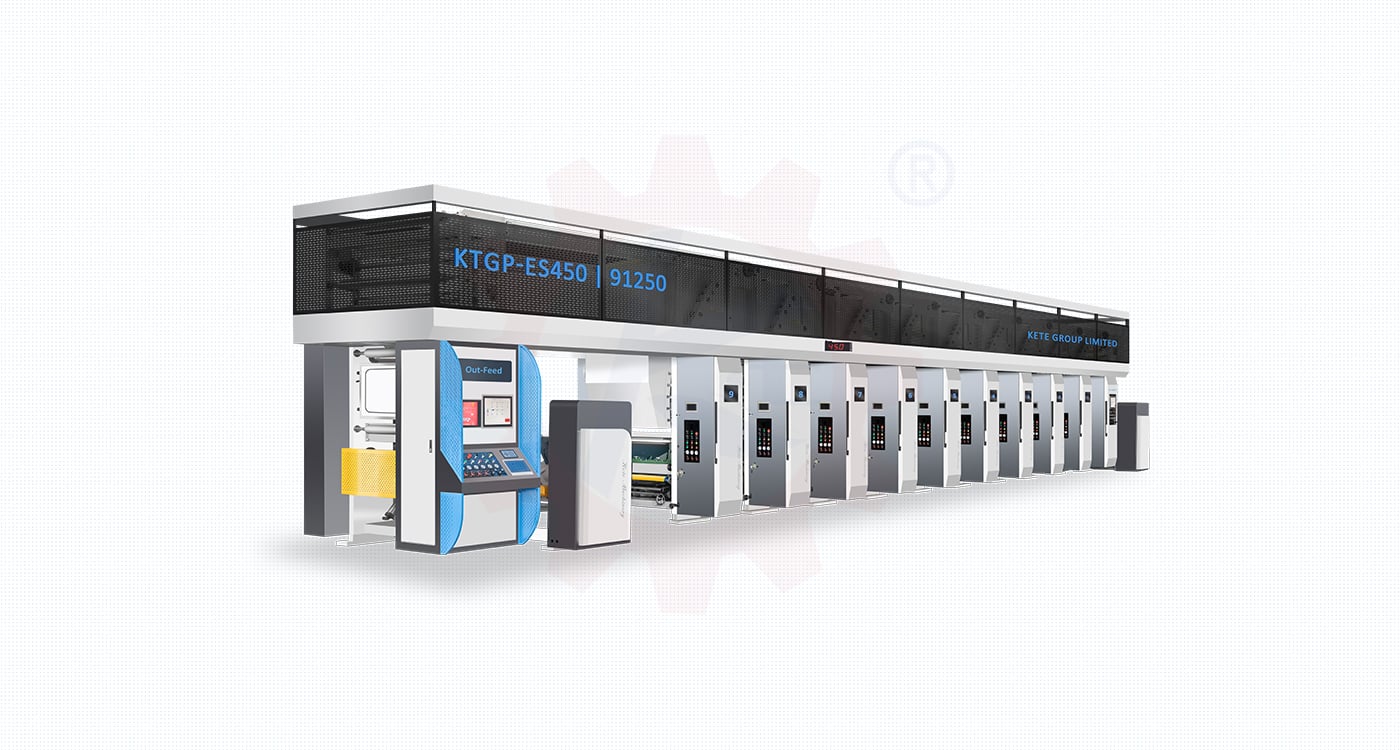
There is no single answer to the rotogravure printing machine price question — and any supplier who gives you one without asking about your substrate, web width, color count, and speed requirements is not worth your time. That said, the market does have clear pricing bands. Here is what you can expect at each tier.
| Livello | Fascia di prezzo (USD) | Typical Configuration | Il migliore per |
|---|---|---|---|
| Entry-Level | $5,000 – $50,000 | 1–4 colors, 600–800mm web width, 60–120 m/min, basic mechanical registration | Small-batch production, startups, single-product lines |
| Mid-Range | $50,000 – $250,000 | 6–8 colors, 800–1,300mm web width, 150–250 m/min, computerized register control | Mid-size flexible packaging converters, multi-SKU production |
| Alta gamma | $250,000 – $4,000,000+ | 8–12 colors, 1,300–1,700mm web width, 300–450 m/min, full servo drive, AI-assisted registration | Large packaging groups, premium color work, 24/7 operation |
These prices are FOB (Free on Board) — the machine cost at the factory gate. They do not include shipping, installation, factory modifications, or environmental compliance equipment, all of which can add 30–40% to your total outlay. We will cover those hidden costs in detail later.
A few real-world reference points to ground these ranges: an Indian-made 8-color automatic machine with 150 m/min speed lists at approximately ₹15.75 lakh (roughly $19,000). A Chinese first-tier 8-color, 1,000mm press with computerized register control typically falls between $65,000 and $200,000 depending on automation spec. At the top end, a European 8-color, 1,300mm line from Bobst or Cerutti runs $1.3 million to $4 million.
Note that the global average unit price of roughly $1,023 — sometimes cited in market reports — is a statistical artifact: it divides total market value by total units produced, lumping everything from $5,000 label printers to $4 million packaging lines into one average. For your actual purchasing decision, this number is meaningless. Focus on the tier that matches your production scale.
Why Rotogravure Machine Prices Vary So Dramatically
Every price quote you receive is a function of five core variables: web width, color stations, automation level, drying technology, and brand origin. Understand these, and you will never be blindsided by a number again.
Printing Width and Color Stations — The Two Biggest Cost Levers
The physical size of your machine and the number of colors it prints are the most intuitive price drivers — and the most consequential.
Each additional 100 millimeters of web width adds approximately 15–20% to the base equipment price. A 1,000mm machine is typically about 30% more expensive than an 800mm equivalent with the same specifications. The relationship is not perfectly linear: once you cross the 1,300mm threshold, the cost per additional 100mm rises to 20–25%, because the mechanical frame, drying hoods, and tension control systems all need substantial reinforcement.
Color stations follow a similar logic. Each additional printing unit adds roughly $20,000–$30,000 in mechanical components (cylinder carriage, doctor blade assembly, impression roller) and another $10,000–$20,000 in electrical control systems (servo motor, drive, registration sensors). An 8-color machine is the current industry standard for flexible packaging — fewer than six colors on a new machine is increasingly rare, as brand owners demand more complex graphics.
There is also a compounding effect: every additional color station raises the complexity of the registration control system. Keeping eight colors in register at 250 meters per minute is not simply twice as hard as keeping four in register — the control challenge scales non-linearly. This is why the price gap between a 6-color and an 8-color machine is often larger than the gap between 4-color and 6-color.
Automation Level — From Manual to Fully Servo-Driven
Automation is where smart money separates from wasted money. Every dollar you spend on automation reduces your dependence on skilled operators — and skilled gravure operators are both expensive and hard to find.
The automation ladder has four clear rungs. Basic automatic register control adds $40,000–$60,000 and delivers ±0.1mm accuracy — adequate for general packaging work where tight registration is not brand-critical. Full automatic register control costs $70,000–$160,000 and tightens tolerance to ±0.02mm, which is the effective floor for high-end flexible packaging with photographic imagery. Robotic automatic roll change adds another $100,000–$200,000 and eliminates the production stop for splice-over — worth it if you run long, uninterrupted jobs. At the top, fully shaftless servo-driven systems replace the mechanical line shaft with independent digital motors on every station, enabling ±0.01mm accuracy, automated job changeover, and remote diagnostics.
By 2025–2026, 92% of new Chinese-manufactured gravure presses now integrate AI-assisted registration systems, up from roughly 40% five years ago. The technology gap between Chinese high-end and European mid-range has narrowed dramatically — a Chinese machine built with Bosch Rexroth servos and Japanese ceramic anilox rollers can achieve ±0.02mm registration, which matches or exceeds the real-world performance of many European presses from a decade ago.
Drying Technology and Brand Premium — The Overlooked Price Drivers
Drying systems and brand origin are the two variables that first-time buyers most often underestimate — and together they can account for 25–50% of the total equipment cost.
Your drying system choice is dictated by your ink type, and there is no one-size-fits-all answer. Electric heating runs $20,000–$40,000 per color unit and works well with solvent-based inks at moderate speeds. Infrared drying raises that to $30,000–$50,000 per unit and offers faster evaporation for water-based inks. UV curing is the most expensive at $60,000–$90,000 per color unit but enables instant curing, zero VOCs, and compatibility with non-porous substrates. The trap buyers fall into: selecting a drying system on equipment cost alone. An undersized dryer bottlenecks your entire line speed. The production capacity you lose over five years dwarfs whatever you saved upfront.
Brand premium is the second silent multiplier. European manufacturers — Bobst (Switzerland), Cerutti (Italy), Windmöller & Hölscher (Germany), Uteco (Italy) — command 30–50% premiums over comparable Chinese high-end machines. Japanese brands like Fuji Machinery and Sumitomo Heavy sit in the middle at 20–35% above Chinese equivalents. What you are buying with that premium is not just the machine: it is DIN Grade 3 gear precision, 15–20 year design life, MES integration readiness, and the near-certainty that spare parts will be available in 2035. A Chinese first-tier machine typically delivers 8–12 years of service life with proper maintenance — entirely adequate for most converters, but a different value proposition than a 20-year asset.
The practical sweet spot in 2026 is increasingly the hybrid approach: a Chinese first-tier mechanical platform with imported European servos, Japanese anilox rollers, and a European-designed drying system. You get near-European registration accuracy at roughly one-third to one-fifth the price.
China vs. India vs. Europe — Where Should You Buy?
Where you buy is ultimately a question of your risk tolerance, not your patriotism. The same 8-color, 1,000mm specification costs $200,000 from a Chinese first-tier manufacturer, roughly $50,000–$70,000 from an Indian builder, and $2 million from a European brand. The machine is not ten times better — but the purchasing experience, the predictability, and the long-term support are fundamentally different.
| Dimensione | China Tier-1 (Wenzhou/Rui’an) | India | Europe (Switzerland/Italy/Germany) |
|---|---|---|---|
| Prezzo tipico (USD) | $65,000 – $400,000 | $20,000 – $70,000 | $1,300,000 – $4,000,000 |
| Registration Accuracy | ±0.02mm (with imported servos) | ±0.10–0.15mm | ±0.01mm |
| Velocità massima | 250–350 m/min | 150–250 m/min | 350–450 m/min |
| Expected Service Life | 8–12 years | 5–10 years | 15–20 years |
| Delivery Lead Time | 3–6 mesi | 2–4 months | 8–12 months |
| After-Sales Response | ≤24 hours (domestic) | ≤24 hours (domestic) | 24–72 hours |
| Spare Parts Lead Time | Immediate | Immediate | 1–3 months |
| Il migliore per | Budget-conscious buyers who need solid performance | Ultra-low-budget, basic packaging | Zero-risk-tolerance multinationals |
China now accounts for over 60% of global rotogravure printing machine manufacturing capacity, with the Wenzhou-Rui’an corridor in Zhejiang province serving as the industry’s geographic center of gravity. The cluster effect matters: hundreds of specialized component suppliers, a deep labor pool of gravure engineers, and fierce local competition that drives continuous improvement. A Chinese machine’s real-world market share is substantially larger than what English-language Google SERPs suggest — European brands are overrepresented in search results because of stronger SEO and content marketing, not because they sell more units.
Indian machines occupy the extreme budget tier. They are mechanically simpler, rely more on operator skill than automation, and their after-sales networks are largely confined to South Asia. For a converter in Africa or the Middle East buying an Indian machine, the cost savings can evaporate quickly if a critical component fails and the nearest technician is a plane ticket away.
European machines are the safe choice — and you pay for that safety. The total cost of ownership argument for European equipment becomes compelling only at very high utilization rates (20+ hours per day, 300+ days per year) where the longer service life and marginally higher uptime compound over a decade. For the typical mid-size converter running one or two shifts, a well-specified Chinese machine with imported critical components is the rational economic choice.
In 2026, the smartest buying strategy is increasingly a hybrid: a Chinese first-tier mechanical platform with imported European servos, Japanese anilox rollers, and a European-designed drying system. You get near-European registration accuracy (±0.02mm) at roughly one-third to one-fifth the price.
The Hidden Costs No One Talks About — Total Cost of Ownership
The purchase price is only 60–70% of what you will actually spend in your first year of operation. The remaining 30–40% is what you discover after the machine is bolted to your factory floor. Here is what that looks like — and how to budget for it.

Cylinder Costs — The Single Biggest Hidden Expense
Gravure cylinders are best understood as “consumable tooling” disguised as a capital item. Every new design requires a new set of engraved cylinders, and the cost adds up faster than most buyers anticipate.
A single gravure cylinder costs between $70 and $200, depending on its dimensions, the engraving complexity, and whether it requires copper plating and chrome finishing. For an 8-color job, that means $560–$1,600 per design in cylinder costs alone. If your operation runs 30 different SKUs, each requiring its own cylinder set, your initial tooling investment could range from $17,000 to $48,000 — before you have printed a single meter of film.
The per-unit economics are what make gravure work at scale. At short runs of 100,000 meters, cylinder amortization can represent 28–35% of total job cost. At 500,000 meters and above, that share drops to 8–12%. This is why gravure and flexo serve different markets: if your average run length is below roughly 200,000–500,000 linear meters per SKU, flexographic printing’s lower tooling costs will give you better unit economics. Above that threshold, gravure’s speed and consistency take over.
Cylinder management is its own operational discipline. Cylinders need chrome re-plating every 3–5 print runs, proper storage to prevent corrosion, and tracking systems so you can find the right cylinder for a repeat job. Some large converters invest $300,000–$800,000 in an in-house cylinder engraving line — an investment that typically pays back in 2–4 years if you consume more than 500 new cylinders annually.
Energy, Maintenance, and Compliance — The Monthly Drain
Operating costs are the silent budget-killer. A mid-range high-speed gravure press draws 80–150 kW per hour of electricity and, if gas-heated, an additional 15–30 cubic meters of natural gas per hour. At 400 operating hours per month and industrial electricity rates, your monthly energy bill for a single press can easily exceed $3,000–$8,000 depending on local tariffs.
Maintenance costs follow a predictable rhythm. Budget 2–3% of the equipment purchase price annually for routine maintenance. Every five years, set aside an additional 8–12% for a major overhaul — bearing replacements, roller re-grinding, control system upgrades. The consumables clock ticks constantly: doctor blades need replacement every 4–8 hours of operation at a cost of $0.10–$2 per millimeter of blade length, and impression rollers require periodic re-covering at $2,000–$5,000 per cycle.
Then there is environmental compliance. Volatile organic compound (VOC) treatment systems — required in most jurisdictions for solvent-based gravure printing — cost $120,000–$300,000 to install, plus ongoing operating costs for activated carbon replacement or thermal oxidizer fuel. Water-based inks eliminate the VOC problem but require 30–50% more drying energy. There is no free lunch: every ink choice has a cost consequence somewhere else in the system.
Calculating Your Real Payback Period
Let us put all these numbers into a working model. Suppose you purchase a Chinese mid-range 8-color, 1,000mm gravure press for $200,000:
- Equipment: $200,000
- Installation and commissioning (5–8%): $14,000
- Factory modifications (power, foundation, ventilation): $50,000
- Environmental compliance (VOC treatment): $150,000
- Initial cylinder inventory (15 designs × 8 colors × $120 avg): $14,400
- Total initial investment: approximately $428,400
Payback period = total initial investment ÷ monthly gross margin = $428,400 ÷ $70,000/month ≈ 6.1 months.
Now the revenue side. At a typical flexible packaging processing fee of $800–$1,500 per ton (depending on your regional market and print complexity), running 150 tons per month at $1,100 per ton average generates $165,000 in monthly revenue. Direct costs — ink, substrate waste, energy, operator labor, cylinder amortization — typically consume 50–60% of that, leaving a monthly gross margin of roughly $66,000–$82,500.
Dividing the $428,400 initial investment by a conservative $70,000 monthly gross margin gives you a payback period of approximately 6–7 months at full capacity. At a more realistic 70% utilization rate, expect 14–18 months. These are the numbers that matter — not the $200,000 sticker price, but the $428,400 real cost and the 14–18 month recovery timeline.
How to Evaluate Suppliers and Negotiate the Best Deal
Getting a fair price is one thing. Making sure the machine actually works when it arrives at your factory is an entirely different challenge — and far more expensive to fix after the fact than to prevent upfront.
How to Vet a Rotogravure Machine Supplier
Cross-border machinery procurement carries asymmetric risk: the supplier has your deposit, and you have a promise. Here are six criteria to separate serious manufacturers from traders and time-wasters.
Factory longevity. Prioritize manufacturers with 10 or more years of operating history. A factory that survived the 2015 and 2020 industry downturns has demonstrated resilience that a two-year-old trading company simply has not. But do not treat the business license date as gospel — many Wenzhou-Rui’an gravure manufacturers registered new corporate entities after 2011 while their founding teams have been building printing machines since the 1980s. Ask who founded the company and what they did before.
Verifiable certifications. ISO 9001, CE marking, and RoHS compliance logos on a website mean nothing by themselves. Ask for the certificate number and verify it independently against the issuing body’s public database. A legitimate manufacturer will provide this within hours; a trader will stall.
On-time delivery track record. Target suppliers with a documented ≥98% on-time delivery rate. Ask for evidence: shipping documents from their last five export orders. If they cannot produce them, assume the worst.
Reorder rate. A reorder rate above 30% is among the strongest signals of genuine customer satisfaction in industrial machinery. A buyer who returns for a second machine is voting with their company’s money.
Response time. Send a technical question outside of business hours and measure how long a substantive answer takes. Under four hours suggests a well-staffed service infrastructure; over 24 hours suggests that technical support is a one-person operation.
Real customer references. Ask for at least three references you can contact directly — ideally in your region, running machines similar to what you are buying. A video call with an existing customer is worth a hundred brochure pages.
Commission a third-party factory audit through SGS or Bureau Veritas. At $1,000–$3,000, it costs a fraction of a percent of a typical machine purchase and will surface structural issues — understaffed quality control, disorganized assembly lines, missing calibration records — that no video call will reveal.
Payment Terms, Contracts, and Factory Acceptance Testing
How you pay is how you protect yourself. The industry-standard payment structure for cross-border machinery purchases is 30% deposit at contract signing, 60% before shipment (upon passing Factory Acceptance Testing), and 10% after installation and operator training at your facility. This structure keeps both parties aligned: the supplier has enough upfront capital to begin production, but the bulk of the payment is contingent on the machine working.
For first-time buyers or purchases above $100,000, a Letter of Credit (L/C) adds a layer of bank-guaranteed security — though it also adds 1–3% in banking fees. For smaller purchases, Alibaba Trade Assurance or equivalent platform-based escrow services provide reasonable protection at lower cost.
The single most important document in your purchase is the Factory Acceptance Test (FAT) protocol. This must be a written appendix to your contract, not a verbal agreement, and it must specify measurable criteria: registration accuracy within ±0.1mm (or ±0.02mm for high-spec work), color consistency ΔE ≤ 1.5 across a continuous 30-minute print run at the agreed operating speed, web tension stability within ±3–5% through acceleration and deceleration cycles, and successful printing on your actual substrate with your actual ink — not the supplier’s optimized demo materials.
Any supplier who resists putting measurable acceptance criteria in writing is telling you something important about their confidence in their own machine.
When evaluating suppliers against these criteria, look for manufacturers who can demonstrate specific, verifiable track records rather than generic marketing claims. Kete Group, for instance, has delivered complete rotogravure-to-pouch-making production lines to Russian packaging converters — integrating the gravure press with laminating, slitting, and pouch-making equipment as a turnkey solution — and has machines running continuously for over two years at Kenyan facilities. Concrete installation evidence like this tells you more about a supplier’s quality control and after-sales infrastructure than any brochure ever will. Equally important are pre-shipment commitments: a supplier who offers to run a free sample printing test using your own materials before you pay the shipment installment is putting their machine’s performance on the line. Requesting video documentation of production milestones — at 30%, 60%, and 90% completion — gives you visibility into the build process and prevents the all-too-common scenario of discovering, three days before the ship date, that your machine is still in pieces on the factory floor.
Negotiation Tactics That Actually Work
Negotiating a rotogravure printing machine is not like buying a car — but some principles carry over. Here are four tactics that experienced buyers use.
One: Send a specification sheet, not a generic inquiry. When you email a supplier saying “send me your price list,” you signal that you are a tire-kicker. When you email a detailed RFQ specifying your substrate type (BOPP, PET, PE), desired web width, color count, target speed, and integration requirements, you signal that you are a serious buyer who is simultaneously requesting quotes from multiple suppliers. The quality of response you get — and the price — will be materially different.
Two: Negotiate the landed cost, not the machine price. A $200,000 FOB price with free first-year spare parts, one week of on-site operator training, and CIF shipping included is often a better deal than a $180,000 FOB price with none of the above. The supplier’s cost to include training and spares is far lower than your cost to procure them separately. Ask for both FOB and CIF quotes, and ask for a first-year recommended spare parts list with unit prices locked in writing.
Three: Time your purchase strategically. Chinese factories are most motivated to close deals in the weeks before Chinese New Year (January/February) and at the end of each quarter. European manufacturers have similar dynamics around their August holiday shutdowns and December fiscal year-end. A purchase order that lands in the last week of a slow quarter can yield 5–10% better terms than the same order placed in March.
Four: Bundle for volume. If you anticipate needing additional equipment — a laminating machine, a slitting machine, pouch-making equipment — within the next 12–18 months, negotiate the rotogravure press and at least one downstream machine as a package. Multi-machine purchases typically unlock 8–15% total discounts. Even if you are not ready to buy the second machine now, getting a written option price valid for 12 months locks in the bundle rate.
A negotiating point that many buyers overlook: currency exposure. A 3–6 month production cycle means the exchange rate between your currency and the supplier’s can shift meaningfully between deposit and final payment. If you are paying in USD to a Chinese supplier whose costs are in RMB, a 5% RMB appreciation during your build period could trigger a renegotiation demand. Include a currency adjustment clause: if the exchange rate moves more than 3% during the contract period, the price adjusts by a pre-agreed formula. This protects both sides and prevents a deal from collapsing at the shipment stage.
A 3–6 month production cycle means exchange rates can shift 5% or more between deposit and final payment. Include a currency adjustment clause in your contract: if rates move more than 3%, the price adjusts by a pre-agreed formula. This protects both sides from a deal collapsing at shipment.
Is a Rotogravure Machine the Right Investment for Your Business?
After everything we have covered — the price ranges, the cost drivers, the regional trade-offs, the hidden TCO, and the procurement process — the question comes back to you: is this the right machine for your business right now?

Start with a quick self-diagnosis. Are your average production runs above 200,000–500,000 linear meters per SKU? Is your product portfolio relatively stable, without constant design changes? Do you have — or can you budget for — operators with gravure experience, or the training to develop them? Is your factory equipped to handle the power load, the VOC compliance requirements, and the cylinder storage infrastructure? If you answered yes to most of these, a rotogravure press is the right capital investment. If you answered no to more than two, flexographic or digital printing may serve you better at your current scale.
Do not overlook the used equipment market as a middle path. An 8-color used rotogravure press can be sourced for $8,000–$63,000 depending on age, condition, and origin. The catch is that cylinder costs, refurbishment, and installation remain the same as a new machine — the equipment saving is real, but it does not eliminate the hidden costs we covered earlier.
If your assessment confirms that rotogravure is the right route, your next step is straightforward: prepare a detailed specification sheet with your substrate, target web width, color count, and speed requirements. Send it to three to five manufacturers. Ask each for a full landed-cost quote that includes installation, operator training, and a first-year spare parts package. And before you sign anything, ask for a sample print test using your own materials — a supplier who is confident in their machine will say yes without hesitation. Kete Group, which offers free consultations with production cost estimates, virtual factory tours, and a first-time buyer guide, is one of the manufacturers worth including in your comparison set.
Send your substrate, web width, color count, and speed requirements. We’ll return a full landed-cost quote with installation, training, and a first-year spare parts package included.
Get a Free QuoteRiferimenti
- 360iResearch. “Rotogravure Printing Machine Market by Ink Type, Type, Application, End User Industry — Global Forecast 2026-2032.” 2026. marketresearch.com
- LP Information Inc. “Global Computerized Rotogravure Printing Machine Market Growth 2026-2032.” 2026. marketresearch.com
- Grounded Packaging. “Rotogravure vs Digital Printing for Flexible Packaging.” groundedpackaging.co
- UGI Packaging. “Gravure Printing Cost Guide: MOQ & TCO.” ukugi.com
- Kete Group. “Casi di studio.” ketegroup.com
- Kete Group. “Rotogravure Printing Machine.” ketegroup.com
- Kete Group. “Contatti.” ketegroup.com
- Kete Group. Pagina iniziale. ketegroup.com